
Mind over matter
A researcher asks: Where does one draw the line between consciousness and nonconsciousness?
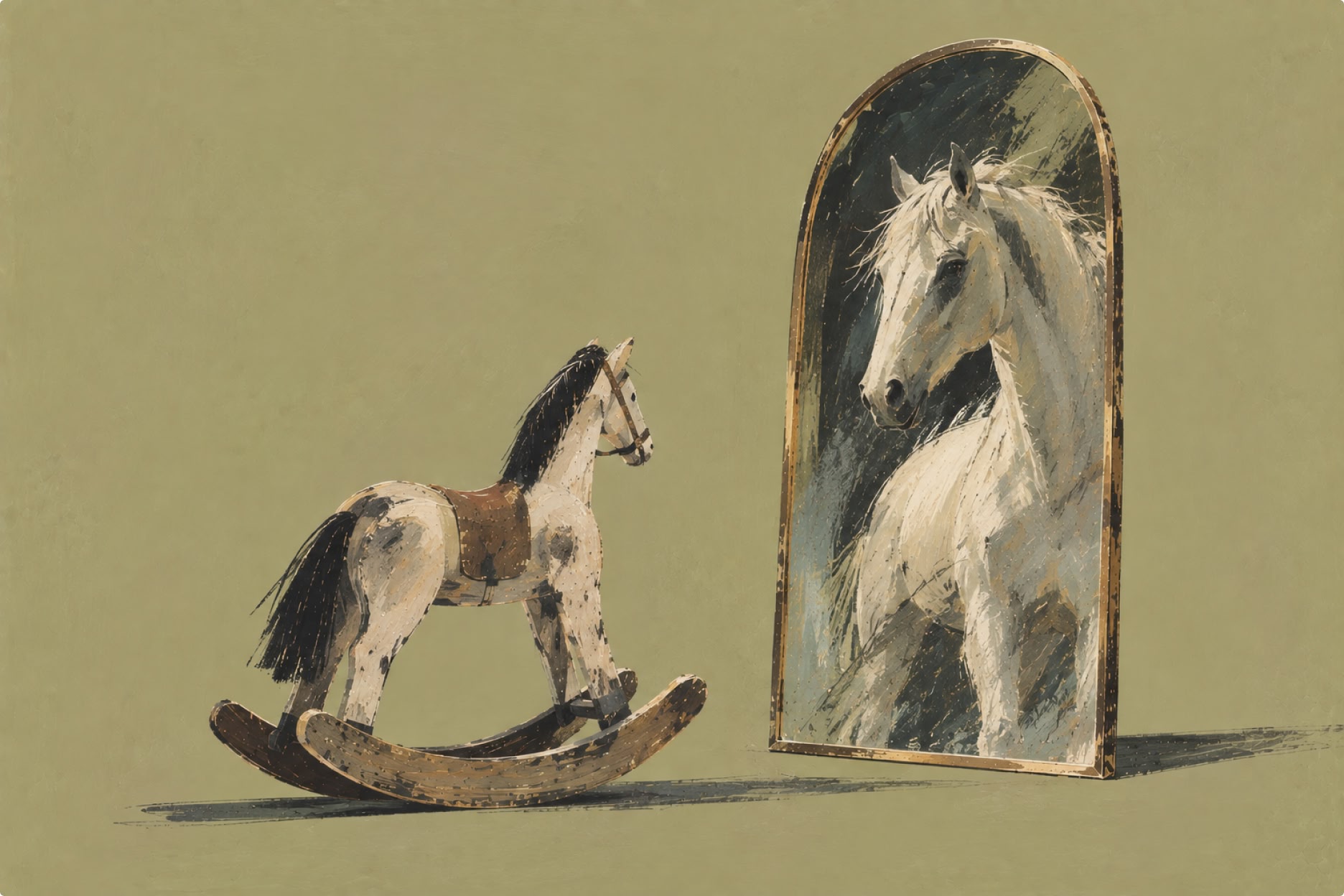
Alive, awake, aware. These three words are explicitly or implicitly present whenever there’s a question of what it means to be conscious. They suggest an evolution of complexity: an organism must be alive, to be awake and then aware of the self to be considered conscious. And while lately the conversation is about whether artificial, human-made systems can be conscious or not, the roots of the problem for organic beings have not reached a consensus yet either. Where is the line between consciousness and its absence? Where do the field experts stand on this debate? And, perhaps most importantly, on which side of the fence do we land?
“Are they conscious?”
It is not a simple question to answer. Your background will completely shape how you will interpret it. If you’re an AI developer, it might be a question you’ve heard about the systems that you work on. If, on the other hand, you work with model organisms (species that have been extensively studied for a specific phenomenon/system and whose knowledge can be extended to other species) like fruit flies, it is a surprisingly frequent question you get about the little insects that plague fruit bowls all over the world. And if you’ve ever had surgery, you know this is also a question asked about a patient under anaesthesia.
I set out to write this piece as an exposition of the different theories and leading expert views on consciousness. But you can find those by the dozen whenever you open a search engine and type in the relevant words[1]. What you don’t find, quite often, is the anger that lingers behind these discussions when something close to your heart heats up your argument.
Is language what defines someone or something as conscious?
You will find discussions on whether consciousness is about how thoughts have access to a workspace[2] and expanding, or how maybe the experience of consciousness arises when different parts of the brain interact[3]. But these don’t help you understand whether the person you see behind your parent’s eyes, shaded by dementia, is the same conscious one that saw you grow up.
And what about the humans who don’t recognize themselves? In “Flowers for Algernon”, a novelette-made-novel written in 1958 where the main character’s low IQ is artificially increased via surgery into genius levels, Daniel Keyes’ thought experiment showed such a complex side of a character who undergoes the abrupt understanding of who he was, while losing it further along. It opened questions regarding the perception that society has of such individuals. And while this was written almost seven decades ago, the stigma is still there. Is language what defines someone or something as conscious? Is my nephew, who is non-verbal and struggles with eye contact or making his feelings and thoughts known, lesser than a machine that can mimic human speech?
Did you feel it, just now? The discomfort of having the conversation veering closer to home. The skipped beat, the held breath, the anticipation that now what I’m going to say is forcing you to look at the problem beyond the scientific question. I started this as the scientist who has spent most of her career caring about neuro, but I shifted to the daughter and aunt who sees the darkness hiding in the words of the discourse.
Do my words have less weight because I stand behind them with my soul? Or should I just stay in the coldness of rationality? The argument becomes ad passiones instead of the critical thought that is expected of me when the initials get added after my name.
We find similarities in the flaws of our mirrors that we discredit as disparities in others.
But at the end of the day, we still need doctors to make decisions. We need them to critically access what is the state of someone’s life. There are different scales that have evolved with time and technology, that went from telling whether the person responds physically to stimuli to measuring the deep brain waves, the measurement that has changed the fine line of decision on whether someone is alive. The overall larger field went from considering only humans to be self conscious to certain animals too, with more being added to the tally. But all the definitions are around what we consider to be human factors of consciousness.
For such an incredibly anthropomorphizing species, who sees the reflection of the self everywhere, either animals, deities or machines, we quickly dehumanize the people who are deemed different. We find similarities in the flaws of our mirrors that we discredit as disparities in others.
Maybe animals look at us and know of their selves more than we can comprehend.
I don’t mean to say that it’s not important to try and define consciousness. On the contrary – I think it has more layers, more considerations than looking at the problem and fitting the solution inside a constrained box. Our language perhaps isn’t enough to find the definitions that we’re looking for, or our methods are still too rudimentary.
Maybe we made machines that one day will be aware of what they are. Maybe animals look at us and know of their selves more than we can comprehend. Regardless, while my nephew might not know the depths of his being, he knows who he is. And while my dad might be forgetting his sense of self, he was here; he existed, and all I know, all that I can know, is that at this moment, so do I.
Footnotes:
[1] Seager, W., 2002. Theories of consciousness: An introduction. Routledge.
Vithoulkas G, Muresanu DF. Conscience and consciousness: a definition. J Med Life. 2014 Mar 15;7(1):104-8.
Seth, A.K. and Bayne, T., 2022. Theories of consciousness. Nature Reviews Neuroscience, 23(7), pp.439-452.
[2] Global workspace theory. Baars, B.J., 1988. A cognitive theory of consciousness.
[3] Integrated information theory. Tononi, G. An information integration theory of consciousness. BMC Neurosci 5, 42 (2004).