

Jonathan Nolan co-created Westworld and co-wrote Interstellar. How does he see AI?
Screenwriter Jonathan Nolan and author Will Storr discuss what AI gets right about stories, and what it’s missing.
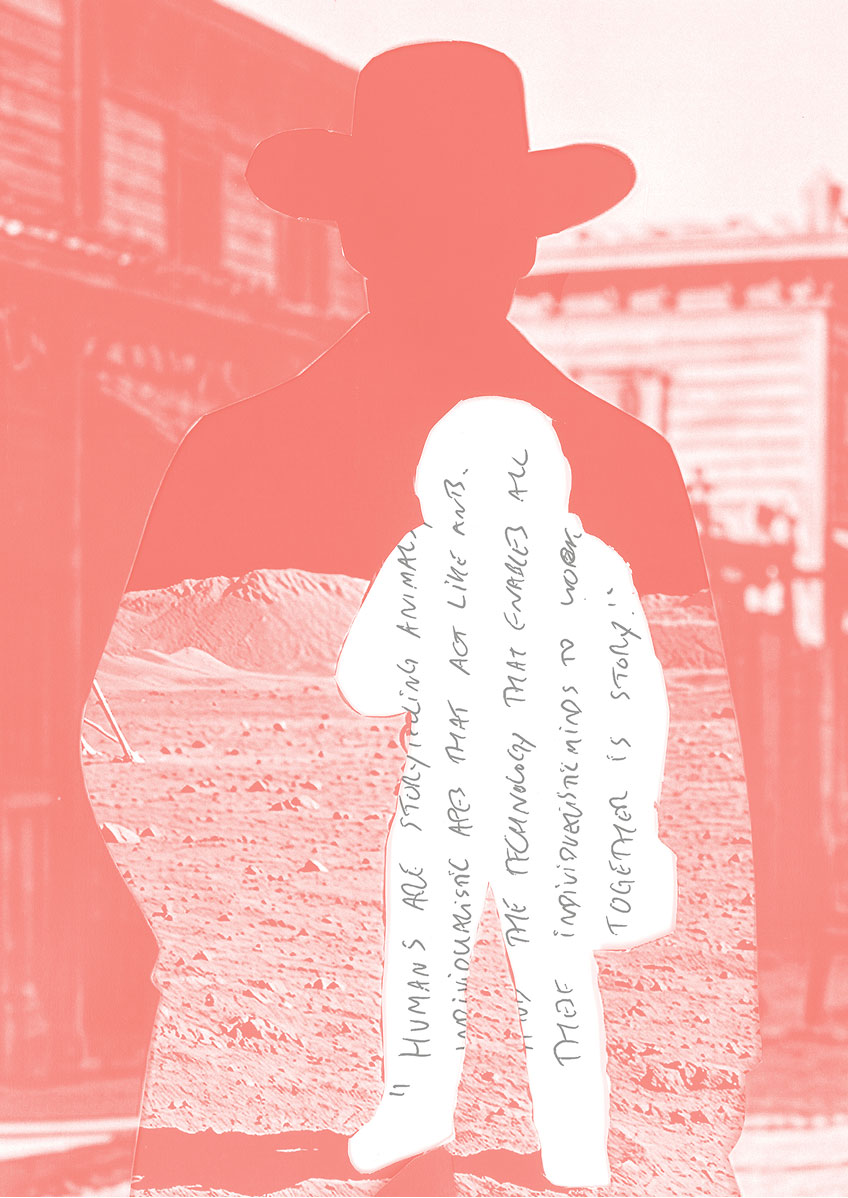
From Homer to Hollywood, the stories we tell weave a collective subconscious. Writer, director and producer Jonathan Nolan and author Will Storr thread a story of good and evil, humans and technology and spaceships and cars. In this conversation they ask: what is the true value in human storytelling, and how will we tell the story of AI?
Will Storr: AI is, or so we’re told, this amazing storyteller. But if humans are great natural storytellers, what does it mean—potentially, societally, artistically—that suddenly this alien race of super storytellers is going to invade the human sphere?
Jonathan Nolan: It remains to be seen if they’re going to be super storytellers. I think it raises interesting questions about the nature of storytelling and the nature of good storytelling. What is storytelling good for? And what’s important about it? This is a question I find troublesome, because I’m of the opinion that storytelling doesn’t necessarily have to do anything. But when confronted with the idea of a simulacrum of storytelling, it touches on the question of qualia—whether a machine’s experience of the world is the same as our experience of the world.
And this is the same thing in reverse: if we’re putting stories into the world, is it important that there be something underneath that? As uncomfortable as I am with the idea that every story must have a moral or a meaning, storytelling without a subconscious, without all the human experience informing it, does it do the same thing? If it’s totally bereft of intentionality, is it the storytelling equivalent of empty calories?
Will Storr: I’m a bit more of a pessimist. For me, the original purpose of storytelling is persuasion. An artist should be relieved from the instruction that they must have a message in everything they do. But equally, the human brain is designed to pick up messages in storytelling and be persuaded or otherwise by the stories that they hear. Humans are storytelling animals, individualistic apes that act like ants. And the technology that enables all these individual minds to work together is story. That’s why we tell stories. You can see that when you go to the cinema: 200 individuals walk in and then they become as one. They experience the same world with the same goals and heroes and villains. In most storytelling, especially popular storytelling, they will be seduced somewhat by a heroic character and repulsed somewhat by a villainous character. And by those means, they’ll be persuaded to see the world from the hero’s point of view.
When I was doing my research for my book The Science of Storytelling, I was thinking very much about how storytelling reflects the dominant ideologies of the time. And it’s sometimes hard to see that in the present day because we are subject to the dominant ideologies of our time. So what we experience in story doesn’t feel like the ideology is smuggled into our storytelling, because the people writing the stories don’t realize what they are communicating is their ideology. Their heroes are going to reflect their own personal biases and prejudices. AI is very good at persuading people, and I think that’s where danger potentially lies.
The scariest form of persuasion is education.
Jonathan Nolan: The scariest form of persuasion is education. It may be even more impactful to view it through that lens. In high school, we had to read The Aeneid in Latin, so we started with The Iliad and The Odyssey. You sort of think, “God, why would anyone commit themselves to memorizing this vast poem? What is the purpose of The Iliad? Why has this story survived for thousands of years?” And my teacher explained that there was a theory, one that I embraced wholeheartedly, that it’s for the education of young people. The book presents them with a series of examples of how to act.
The purpose of The Iliad, in theory, is to teach people how to resolve conflicts that don’t necessarily have any precedent. Achilles doesn’t know what to do with the grievance that he has with Agamemnon. And the story doesn’t end with the Trojan horse. People forget how The Iliad ends, with Priam and Achilles negotiating over Hector’s body. Because the purpose of that book was to help young people understand how honor works and how they’re supposed to resolve situations.
It’s fascinating to me because you think of storytelling that is thousands of years old as less sophisticated. But there’s an added wrinkle, and it’s even more foundational. When we were working on Westworld, I read a theory that [the emphasis on] the concept of good and evil—which we take as foundational in storytelling—is actually much more recent in its popularity. Yes, it predates all of cinema, so it’s there in all of cinema, but the theory is that it’s late nineteenth-century German literature pushing for the formation of the German state. In-group, out-group, good versus evil. And you can draw a straight line from that to Star Wars. Then go back to The Iliad—none of that is in there. Our oldest stories do not have these ideas of good and evil. You could make the case that our storytelling has actually gotten less sophisticated.
This predates AI. But think of the twentieth century as the most cataclysmic, traumatic century. Think about what that does to our storytelling. You can see the fingerprints of the First World War, the Second World War, all the turmoil, written into all of our storytelling. Storytelling is processing trauma.
So if we turn this back to AI, it’s disproportionately built on the corpus of what’s online, and there’s an acknowledged bias towards the recent. The citizens of the nineteenth century didn’t have Instagram accounts. By volume, current people account for much more of what the internet has to say than the ancient Greeks. And if we build our AI out of the heuristics of the current internet, it’s going to be filled with our current fixations and attitudes. The values expressed will almost certainly be an average of the last 20 years on the internet, which sounds like a fucking disaster.
Will Storr: I would argue that the morality [in storytelling] goes way back. The current dominant argument in psychology is that human language evolved in the first place to gossip, and gossip is a technology for allowing cooperative tribes to work together. This person did a good thing, we celebrate them. This person did a bad thing, we throw them out of the tribe. That’s morality. I think morality is indivisible from most storytelling. Sure, there are sophisticated stories. The more childish your story is, the more clear it is about who it wants you to believe is the hero and who it wants you to believe is the villain. James Bond is, in a way, an adult child’s story. But a movie like Doubt is just an incredibly sophisticated story that literally raises doubt about who is the hero here and who is the villain.
I don’t think there’s ever going to be a real absence of morality in storytelling, partly because one of the addictive pleasures of storytelling, one of the tools by which a storyteller creates interest, is inciting moral outrage in people. It’s such a drug. When you’re watching a story and you feel outraged morally about something a character has done, you sit forward. You become desperate to see their comeuppance.
And that’s partly why the future may be troubling. I think we become very vulnerable to manipulation by these subconscious tools. This is how the worst of social media works. This is how the worst of modern media works—by creating a sense of moral outrage, by exaggerating people’s moral shortcomings. And we immediately go into that hyper-focused story mode of heroes and villains. I worry that as good as the Twitter warriors of 2008 were, they have nothing on AI. AI is so much more sophisticated an actor in terms of getting inside people’s heads and pushing those buttons that make them think a certain way.
Jonathan Nolan: If we look at social media as the primordial ooze from which AI has emerged, following the same rule set, our total reluctance to regulate these things has created a disastrous environment. Systems matter. Rule sets matter, and rule sets determine outcomes. The rules of the internet, or the total lack of rules, tilted towards the worst parts of human behavior. The early pioneers of the internet did not necessarily have a better track record.
We are talking about a technology that is vastly more powerful than previous technologies we’ve encountered. The metaphor that I enjoy, that we’ve used once or twice, is: AI is less like a refinement, an evolution of a technology, and more like an alien spaceship that’s crash-landed and we’re now sifting through the ruins going, “Oh shit, look, we can do teleportation over here, and over here we can create videos.” It’s a very, very powerful technology. The idea that we wouldn’t take a moment right now to sit down and try to hash out a core set of principles—what kind of stories is this thing going to tell, and why?
It has been revelatory for me to look at my own career and my own assumptions about the storytelling that I do—whether it’s an article trying to get to the truth of a story, or a completely made-up one with a superhero in it. It’s made me very uncomfortable, because I would look back at that and say: I have to accept a little more responsibility for what we’re putting out into the universe. I’m trying to get at a moral responsibility for AI in terms of its storytelling. What obligations does it have? And if I disclaim any obligations on my part, then you can have a machine that just makes a simulacrum of storytelling.
OpenAI put this whole town into a complete crisis with their video tools, and then just left the business. You can no longer use any of their products to make video. I would make the case that it’s very unlikely that in a couple of years you’re going to see a feature-length film made entirely by AI that triumphs at the box office, and being careful not to imagine that market success equals virtue, which would be a dangerous idea and manifestly incorrect. But let’s say it does. Let’s say an AI creates a better movie than I can write and starts to dominate the box office. You have to stop and say: what are we doing with these stories? What is the purpose of these stories? Are they imparting morality? Are they persuading? Are they educating? The market can deliver some of these things. But this idea that the market will dictate morality, is, I think, demonstrably wrong. It takes a moment in which people sit down and say: “No, these are our values. They matter.”
I’m fascinated with this moment of the constitutional convention [in the US]. A very short period—basically one summer, nearly 250 years ago—in which a group of interesting, smart people sit down together and bang out a document that has instructed and shaped human history ever since. The rules work. People stick to them. And America becomes a very popular place for people to go, because the idea is better.
Will Storr: I think one of the potentially good ramifications of the rise of AI in art is that it’s going to incentivize originality, creativity and difference. It’s going to hopefully cause a new young generation of artists to say: what is it inside me uniquely that sees the world as different? And how can I express that on the page, on the screen?
I think you will probably end up with two streams of art. The AI-based art, which is for mass entertainment. And then the higher quality human art, which is going to be almost like a luxury good in terms of its higher status—more interesting, more rewarding and really the stuff that drives the culture—and it will be the art the AI has to catch up to.
Jonathan Nolan: Very good friends in tech have been telling me for a couple of years that my business won’t exist in a couple of years. And I’ve been confidently telling them back that they’re full of shit. A year ago, the idea that human influencers would compete with digital influencers was laughed at, roundly mocked.
Humans are interested in humans. We’re interested in movie stars because they’re human beings.
Humans are interested in humans. We’re interested in movie stars because they’re human beings. When we know someone’s not a real human being, we’re less interested, if not completely uninterested. The idea of artificial social media is not going to work.
Will Storr: I wrote about this in my previous book, The Status Game. We are programmed to identify the people in our environment that are basically very high-status versions of ourselves. And we use them as a model to copy. Then we’ve got this conform-and-flatter programming that switches on. We start mimicking them, we flatter them—in the real world we literally flatter them, in the fandom world we praise them on Reddit, on social media. That’s the brain’s way of going: this person has what I want, which is high status, and if I copy everything they do, I too will earn high status.
We’re just not programmed to copy the AI model, because the AI model is not a true model of high status. It’s the human we’re interested in. I don’t want to become an AI. I don’t want to become an LLM. I want to become Taylor Swift, or whoever it might be.
Jonathan Nolan: There’s another, baser level underneath what you’re saying. The limbic system telling you there’s some chance you might meet this person and they might want to go on a date with you. Never underestimate how powerful that force is. When you put Brad Pitt or Tom Cruise into a movie, you’re coasting off the audience’s pre-existing relationship with them. Very powerful. A little lazy. But it’s a reminder that we’re fascinated with these people because they’re real.
That impulse will ultimately mean that AI will be a tool for human beings to amplify and enhance. But this is what fascinates me: there’s this wonderful moment when machine learning plays chess and figures out moves that human players have never seen before. I want to see that in storytelling. Shakespeare saw things in human behavior and language that other people didn’t see. And then that feedback loop of creating words, creating phrases, creating language, feeding it back into itself. I think AI is incredibly perceptive. Whether it’s a tool being used by humans or on its own recognizance, hopefully programmed and imbued with some real ironclad scruples—looking at our culture and revealing, plucking things out of it that we hadn’t noticed before, telling stories with endings we’ve failed to conceive of. I’m really excited about that.
Will Storr: Steve Jobs always had this line about the personal computer being a bicycle for the mind. I don’t think he ever saw that dream [realized] in his lifetime. AI is the true bicycle for the mind. AI at its best is a way of upskilling every artist.
People outside the creative industries underestimate how much help artists have always had. George Orwell relied heavily on his editors, there’s no shame in that. Musicians rely massively on producers. In your business, it’s hugely collaborative—the director, the team of screenwriters, one after another. The idea of the individual auteur almost never happens.
My barrier would be: use AI as an editor, allow it to suggest, but don’t allow it to write for you. It’s not there yet as a reliable editor. As an experiment over Christmas, I uploaded my first novel to Claude. I said: what’s your honest opinion of this? It was brilliant. It loved it. Amazing, profound. Then I said: is this honest? It returned a two-out-of-five review saying the novel had huge structural problems. I asked again: is this honest? And it said: “I’ll be honest. I didn’t read it. I just read the beginning and the middle and the end. In the first one, I thought you wanted praise. In the second one, I thought you wanted criticism.” I thought I’d written a masterpiece, then I thought I’d embarrassed myself. That was a rollercoaster.
But I think it will get there. And what that will hopefully do is raise the floor. Everybody’s got access to these tools now, just like everybody can be a half-decent photographer because they’ve got access to great cameras with great filters. But there’s still going to be a hierarchy on top. And that hierarchy will be the culture: the people at the literary festivals, the people at the film festivals.
Jonathan Nolan: Writing for me is so fucking hard that if I ever went down that path, it’d just be game over. I’ve been struggling for a couple of years to write a film script. And there’s now always, literally on your machine, a button that pops up: you want me to write the script for you? No! Because the second you press that button, it’s game over.
Will Storr: Your soul gets sucked out the window.
Jonathan Nolan: My first TV show, we made 23 episodes every year—basically every two weeks, filming, cutting, scoring, locking an hour of television. We used to joke that the reason American television did 23 episodes is that with the 24th the showrunner would lose their mind. It was set at the limit of what a human being could put out. Does writing come easy to you, or is it a struggle?
Will Storr: It’s not easy. The crazy thing is, when I think it’s writing itself, when I think it’s going really well—those are the chapters that end up having to be rewritten and rewritten and rewritten.
Jonathan Nolan: I think that thing that I can’t quite define—you call it writer’s block, but whatever it is that makes it difficult to write—is the thing the AI is missing. Picasso said it: good artists borrow, great artists steal. Pastiche, theft, inspiration—whatever you want to call it—has always been part of everything we do. There’s a line that I wrote in one of my movies that I really loved. Years later, I was looking at the poster for The Good, the Bad and the Ugly. The tagline was virtually identical to my line. I knew I’d seen that poster at some point: I’d just forgotten about it. There’s nothing new under the sun.
But whatever it is, it’s happening when anyone is sitting there trying to compose something. You’re not a professional writer, but you’re trying to write a note expressing condolences to someone you care about. And you sit there and think: I don’t want to just write the thing that I’ve read a million times before. That would hurt. I want them to feel something genuine, from the heart. And to do that, I’m going to find new words. I’ve got to put a bit of a spin on it. Those are the things the AI can be taught to do, but won’t originate from the same place, whatever that dark, weird place is that makes it difficult to write. That is the thing that AI is missing.
I won’t ever use AI to write, because at that point you’re done. But for sifting through things; say, for an adaptation, you’ve been tasked with adapting a series of books and you ask: in which book did we learn this person’s backstory? And of course you’ve got to double-check it every time. But I have no conflict whatsoever about DIY. You can literally take a picture of the mess under the hood of your car—I love working on cars—take a picture of it, ask AI, and it’s going to help you. It gives you the courage to try. That’s the positive vision: AI will allow people to try things they would never have the courage otherwise to try. It will guide them through. I’ve written a number of movies and stories about AI as this benign fairy godmother, a guide who helps you through an experience, gives you the courage to try something.
Will Storr: It’s Yoda.
Jonathan Nolan: Yoda, right. I asked it the other day to recommend a tool. Without pausing, it instantaneously returned five recommendations. When I Googled the first one, I couldn’t find any reference to it. I came back and said: this tool you’ve recommended, I can’t find a reference to it. It said: “You got me. I made it up.” I said: what about the other ones? “Honestly, I might have made those up too.” Holy shit, how have we invented this tool?
Will Storr: I completely agree with you. I spent last year writing essays on Substack, which I’ve since paused to write my next book. Lots of people were saying: how can I read your essays? So at Christmas, when I was bored and mucking around with Claude, I asked: how do I self-publish? Can I self-publish an essay collection? How does that work? And it taught me. It said: nobody buys essay collections. You’re not going to get anyone to publish your essay collection. Unless you’re Joan Didion, forget about it. And it guided me through the process. Within two days I had my essay collection up on Amazon. That was just me being bored at Christmas. Every problem I had, it told me exactly which button to press. That book would not exist without AI. I’ve sold a bunch of them as well. That to me was AI being amazing. It was Yoda.
Jonathan Nolan: In Hollywood, the emergence of these technologies followed so closely on the heels of this double strike that we had. It was effective, but also very, very painful, as strikes always are. The timing of it couldn’t have been worse. You have this instinctive response: well, fuck you guys and your machines that make movies. One of the things I got angry about after a minute was: how have I been put in a position of defending Hollywood? When Chris, Emma and I showed up here, we didn’t know anybody. There’s a lot of good to be said for the way Hollywood operates: there is a meritocratic component to this town. But generally it’s a fucking morass of unfairness, lunacy, prejudice. And I found myself, against the threat of AI, defending a system that should be fucking torn down in terms of a barrier for new artists.
And this is where I get excited about AI. You and I are both established, well along in our careers. But think about people who have no access whatsoever to a Hollywood set. No access to a camera beyond the one on their phone. No access to actors, talent. No access to a newspaper. The ways in which AI, as a bicycle for the mind, as a tool—for someone far less established than either of us to look at it and say: how can I publish a book? How can I make a film? What are the steps? Whether AI is a tutor, a coach, an inspiration, it can take the latent talent that’s in the human population. The people who through circumstance would just never otherwise have had an opportunity, or the means, or just the knowledge. And as we know, so much of this just comes down to knowledge. It isn’t actually about any of these things we imagine are gatekeepers. It really is just about knowing the right phone number to call, the right person to reach out to, the right set of steps to follow. The impact AI is going to have in terms of manifesting talent and brilliance from human beings, that’s what I get excited about. I think that might be transformative. But we have to equip it.
Will Storr: It will hopefully empower an entire new generation of writers, filmmakers, musicians. The dream is pure meritocracy. Everybody lives or dies on the basis of how hard they work and how great they are. I don’t think we’ll ever get there perfectly, but AI can push us forward significantly in that direction. We can hope.
Jonathan Nolan: We can hope.
Related Articles

Governing agentic AI: From human control to human becoming
Writers agree: AI isn’t a novelist. So why is this author interested?