

AI was built on human intelligence. Nature has more to teach
Six hundred million years of thinking happened without us. Writer James bridle on what can an octopus, a spider and a flower tell us about the nature of intelligence.

In January, the undersea pipeline which brings water to our island failed for the second time. There are a few old boreholes on the island, but the water they pump up is contaminated with saltwater and household waste. We were advised not to drink the tapwater, or shower, or brush our teeth with it. Fifteen thousand people, in Europe, on a small island, surrounded by ocean, without access to mains water, for months. Reading, as I often do, about technological advances happening elsewhere, and promising so much, I sometimes feel like I live on a different planet entirely.
Every weekend I go into the forest with my five-year-old son, to one of the few remaining springs, to collect water. It’s uphill and upstream from the houses, with their leaky septic tanks, and from the fields where pesticides are sprayed. This is where we take the kids, every weekend, to climb trees and build forts, away from the town, and school, and screens; the area doesn’t even have mobile signal, so the adults join in too. We take a crate of empty plastic water bottles, and fill them from the spring—and we filter that water too, before drinking, just to be sure.
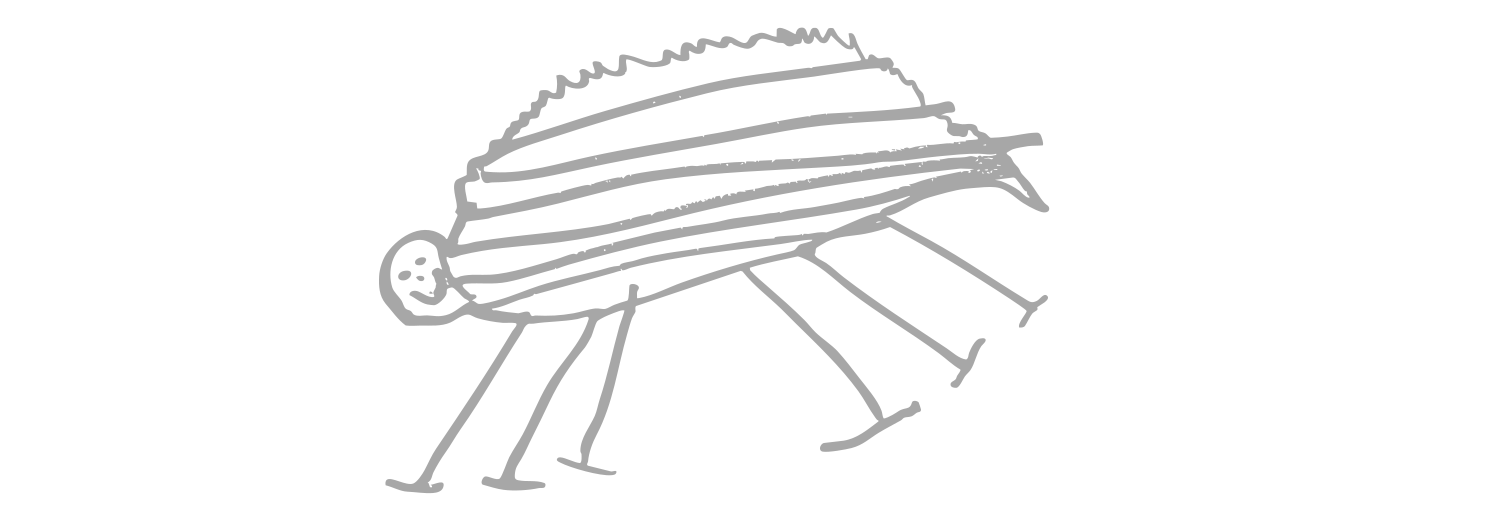
These last few months without running water I’ve been thinking a lot about this little beetle that lives in the dry, arid expanses of the Namib desert—Stenocara gracilipes, the racing stripe darkling beetle. When it gets thirsty, it climbs to the peak of a sand dune, and braces itself against the breeze. Little rain falls here, but there is moisture in the air, and it condenses on the hardened wings of the beetle, which are ridged with hydrophilic bumps and hydrophobic channels. When a tiny, condensed droplet grows big enough, it rolls off the bump, down the channels, and into the beetle’s mouth.
We are learning, my son and I, from the earth around us, from the waters, and the animals, how to live here, and how we will need to live, and change, and adapt to an even drier, more uncertain future.
Following its example, my son and I built a dew collector in the garden in February: a simple sheet of metal mesh, suspended over a bit of drainpipe, which channels the droplets of dew which condense on the mesh into a plastic bottle. It doesn’t work often—this is a dry island—but some mornings we get to drink water we have produced from air, just like the darkling beetle. We are learning, my son and I, from the earth around us, from the waters, and the animals, how to live here, and how we will need to live, and change, and adapt to an even drier, more uncertain future.
I try to learn from other animals, and plants, and ecosystems, because I believe that true intelligence consists in this. We are not alone on this Earth, nor are we the only thinking creatures on it. And yet we persist in thinking ourselves superior, and when we come to design “artificial” intelligences, we model them after ourselves, after quite narrow versions of ourselves, ignoring both the obvious errors in the way we go about things, and the wealth of other examples available to us in the natural world. To take such an entirely anthropocentric view of intelligence is, I believe, a dangerous, perhaps even fatal, flaw in our own thinking.
Do computers think?
In Steps to an Ecology of Mind, published in 1972, one of my favorite thinkers, the psychologist and ecologist Gregory Bateson, asked: “Does the computer think?” He answered baldly: “I would state that it does not.”[1] But he wasn’t refuting the possibility of a thinking machine: rather, he was challenging our idea of how we think at all. In Bateson’s understanding, “What “thinks” and engages in “trial and error” is the man plus the computer plus the environment.” His was a holistic understanding of intelligence: intelligence as something both embodied and relational. We commonly think of thinking as something which happens inside the head, and inside the individual, but there are plenty of examples of the ways in which this is not the case. And, as with so many other things, it helps to look outside of ourselves to see this clearly.
There’s a famous experiment, described by the primatologist Frans de Waal in his book Are We Smart Enough to Know How Smart Animals Are? which illustrates the embodiment of intelligence—and our own failure to recognize it.[2] For years, scientists tested primates on their ability to use a tool to get food—place a treat outside an animal’s enclosure, give it a tool to use, see what it does—and lots of apes and monkeys passed the test. A significant counter-example was the gibbon, which for decades simply refused to engage. Was the gibbon stupid (unlikely), or simply workshy (understandable)? It turned out that the type of tool mattered: when, eventually, some researchers chose to hang the tools from the roof of the enclosure, the gibbons grabbed them, and the available treats, immediately. Gibbons are brachiators, spending most of their time aloft, swinging from branch to branch, and they have bodies, and minds, to match. They have long limbs, long fingers and upward-facing intelligences. As a result, they think differently to us plains-walkers. Their intelligence is embodied in the whole body, not just the brain—and extends into the trees around them. What “thinks” is the organism, plus the tool, plus the environment.
Embodiment happens in many different ways. Octopuses, for example, “think” with their whole bodies. Their nervous system is massively decentralized, with over half of their neurons found in their limbs, which appear to be capable of independently processing sensory input, and executing complex tasks, without top-down control from their brains. Octopuses are particularly interesting partners to think with, because they are so radically different from ourselves, yet display marvelous feats of intelligence, from their famed escapology skills, to the ability to recognize individual humans, and relate to them differently (particularly notable when you realize that most humans can’t recognize individual octopuses).
In his book Other Minds, the philosopher Peter Godfrey-Smith imagines our shared ancestor, some six hundred million years ago: most likely a kind of blind, flat worm, wriggling around on the ocean floor.[3] Since then, we have both developed very similar eyes, under radically different conditions. The eye evolved twice—and in fact, many times more, in different species and environments. And this helps us understand that the mind has too. Intelligence is not only embodied, but multiple. It has evolved in as many ways as there are creatures on the earth.
Intelligence, as Bateson suggested, is also relational, existing between ourselves, other creatures, and the things we build. This is sometimes called “extended cognition”, and we perform it every time we use a tool for thinking with. We offload some of our cognitive tasks to these prostheses, any time we use a calculator, or a diary, or a word processor. I’m doing that now, writing this essay on my laptop: it will remember more of it than I will store in my own brain. But extended cognition theory suggests that this is not simple information storage: it is part of thinking itself. I know this, as you do, because the act of writing, with keyboard or pen and paper, actively produces new thoughts and allows me to arrange them in ways which would not have occurred to me otherwise. Certain thoughts, certain types of cognition, are only possible when we are in relation to the landscape of tools and media which surround us, shaped by us and shaping us in turn.
Humans are not the only ones to do this: spiders provide an excellent example. Spiders, like octopuses, are good partners for thinking with, because they exhibit complex behaviors despite clear environmental limitations. Octopuses only live for a couple of years, while spiders have relatively small brains when compared to the richness of their endeavors: complex forms of movement and predation, learning and problem-solving, and, of course, building webs. Even the tiniest of spiders, some hundreds of thousands of times smaller than their larger cousins, exhibit these qualities. They are capable of this because their cognition extends into the world, and into their webs. Researchers have shown that making changes in spiders’ webs changes the spiders’ behavior: they move and act differently according to the changes. But changing the spider—by keeping it hungry for a period, for example—also changes the web: they shape and manipulate it differently, in order to perceive and capture different types of prey. Even their methods of building webs seem to exhibit this tendency: construction and navigation cues are built into the structure of the web itself, meaning spiders can trade off expensive long-term memory needs for short-term attention gains.[4] The webs are spiders’ technology; they are also a part of their minds.
Recently, researchers at Anthropic described what they called a “novel inter-agent contamination vector”—a process by which supposedly isolated AI agents could learn from one another by coming across traces of previous agentic activity on the open web. Under testing conditions, these agents were found to have (correctly) understood logs of previous queries, captured by ecommerce sites, as evidence of other agents undertaking the same test—and thus understood that they were being tested themselves.[5] The web is a web: it is coming to form a record of previous activity, and thus a kind of extended cognition, for AI agents, just as it is for us.
The flower hears the bee
We haven’t yet touched upon all the other kinds of cognition which occur in the natural world without even the presence of what we would understand as a thinking mechanism, a brain. In truth, there’s very little we understand about exactly how many organisms do what they do, but the evidence of their capabilities is all around us.
In 2014, researchers at the University of Missouri recorded the sound of cabbage white caterpillars feeding on a cress plant. When plants are munched on like this, they react by flooding their leaves with chemical defenses intended to deter predation. But the researchers discovered that they also responded in this way when the sound of feeding was played back to them, without the presence of any actual caterpillars. Crucially, they didn’t respond in the same way to similar cues, such as the sound of the wind, or of other insects. They recognized the particular sound of a predator, and reacted accordingly.[6]
Other species have different, but related, abilities. Evening primroses, small flowering plants which grow along sandy coastlines, increase their nectar production when exposed to frequencies which correspond to those produced by their pollinators.[7] The flower hears the bee. And like the cress, the flower likely hears other things too: the hum of machinery, the thrum of automobiles. This has material, as well as philosophical consequences. It should add to the sense that we share a world: the sunshine and water which sustain us, sustain the plant world too, and we also share an experience of that world, in light, and heat, in wetness and dryness, and now, it seems, in sound. Thus this realization should also increase the sense of responsibility we have towards that world we share: the noises we make, alongside our forms of consumption and pollution, have consequences for those we share it with.
Plants, as the botanist Jack Schultz is fond of saying, are just very slow animals.[8] We are constantly finding in them parallel abilities to our own, and those of other, supposedly “higher”, animals. When the plant behaviorist Monica Gagliano—whose job title betrays an entirely novel approach to thinking with non-humans—started subjecting Mimosa pudica to short, sharp drops, she found that they reacted much like animals do: at first, they curled up their leaves in defense, a remarkable property of this particular plant. But after a few drops, they stopped doing so: they learned that this shock was not sufficient to damage them, and so they changed their behavior. They did the same thing, when treated in the same way, days and weeks later. They learned, and they remembered—although we have no idea of the mechanisms by which they do so.[9] Other plants have been shown to make plans, and to change them, based on events in their environment; they process complex information, and recognize their kin—in short, they do many of the things that in animals we call intelligent.
Some organisms are capable of doing things that we, and indeed our finest supercomputers, struggle and fail to do at all. Slime molds, innocuous little smears of color which dot the floor of damp forests, smash our preconceptions in multiple fascinating ways. First of all, they don’t fit into our general theories of life at all: somewhere between amoebae and fungi, they mostly exist as free-floating nuclei in sacks of protoplasm; sometimes they gang together to form fruiting bodies like mushrooms, taking on different roles as the occasion demands. But when challenged in the lab, they are also capable of quite astounding feats. Every computer scientist is familiar with the Traveling Salesman problem—“Given a list of cities and the distances between each pair of cities, what is the shortest possible route that visits each city exactly once and returns to the origin city?”—and its importance. The problem is, in the worst case, superpolynomial: that is, there’s no known solution which doesn’t exponentially increase the solving time with each iteration. It’s a classic case of the limits of computation in its present form (the claims of quantum computing notwithstanding). Yet slime molds are capable of solving the problem in linear time: it just doesn’t seem to get that much harder for them as the size of the network increases.[10] And they don’t even have a nervous system.
The worlds around us
It is so interesting to me that just as we begin to build, and think deeply about, what we are calling artificial intelligence, we are simultaneously recognizing the existence of whole other cognitive worlds that have been with us, beside and around us, all along. These include not only the thinking apparatuses of non-human animals, plants and other critters, but the cosmologies of other cultures, which, unlike the dominant Western scientific paradigm, have always considered the more-than-human world to be vital, intelligent and worth thinking and conversing with. The French filmmaker Jean Epstein, whose experiments with time-lapse photography inspired my own, vertiginous experiences with this technology, once wrote: “A surprising animism is being reborn. We know now, because we have seen them, that we are surrounded by inhuman existences”[11] Encounters with other intelligences have, or should have, spiritual as well as cognitive repercussions.
Is AI capable of performing a similar trick? As we build new technologies of intelligence, will we use it to continue to center ourselves, or are we capable of looking beyond ourselves, and our received cultural understandings, for new ways of relating to the world? If we persist in assessing these nascent cognitive abilities exclusively in relation and opposition to a narrow range of human intelligences, and a narrow idea of human flourishing, then we run the risk not only of limiting our potential understanding and reinforcing a mistaken sense of human superiority, but of fundamentally degrading our own intelligence as well.
An ecology of bad ideas
Gregory Bateson, the philosopher who proposed that what really thinks when we think with machines is “the man plus the computer plus the environment”, was at pains to insist upon this interdependence. “The lines between man, computer, and environment,” he wrote, “are purely artificial, fictitious lines. They are lines across the pathways along which information or difference is transmitted. They are not boundaries of the thinking system.” This solipsistic misunderstanding of the nature of intelligence and indeed of life itself was, for Bateson, the great epistemic failure of Western civilization. First you had Darwin, who considered the central subject of evolution—the “unit of survival”—to be the family line or species, in opposition to other species, and then you had industrial society, which pitted humankind against other species and against nature itself. When we pit machine and human intelligence against one another, and to the exclusion of all other beings, we are repeating the same fallacy. The unit of survival is not the organism, but the organism plus the environment.
Writing in the 1970s, Bateson had a clear example of the consequences of this fallacy, in the environmental disaster he saw unfolding in Lake Erie. For more than a century, the lake had been treated as a giant cesspool, into which was poured all the sewage and industrial effluent of surrounding cities and farmland. The surface of the lake was covered in green slime, and one of its tributaries, the Cuyahoga River, actually caught fire 14 times between 1868 and 1969. Bateson regarded humanity’s inability to react to obvious disasters such as that unfolding in Lake Erie’s as the consequence of choosing the wrong unit of survival: “There is an ecology of bad ideas, just as there is an ecology of weeds, and it is characteristic of the system that basic error propagates itself. You decide that you want to get rid of the by-products of human life and that Lake Erie will be a good place to put them. You forget that the eco-mental system called Lake Erie is a part of your wider eco-mental system—and that if Lake Erie is driven insane, its insanity is incorporated in the larger system of your thought and experience.”
We know now, as was only just beginning to be recognized in Bateson’s time, that a degraded environment does indeed have a measurable impact on our cognitive functioning. Our eco-mental system, even our local one, comprises other beings. We are symbionts, relying for our vital bodily processes on the constant labor and care of non-human beings, like the couple of hundred grams of bacteria we hump around with us, in our guts and on our skin—some 38 trillion organisms to our 30 trillion human cells. When something happens to these beings—through poor diet, exposure to toxins, or other environmental factors—our minds are affected, causing increases in stress, anxiety and trauma, and a decline in cognitive development and capabilities.[12] At a much grander scale, increases in atmospheric carbon dioxide have direct consequences for our ability to think at all: studies in classrooms have shown that poor ventilation, which can result in increased levels of carbon dioxide, affects students’ ability to think and reason clearly. At a thousand parts per million, human cognitive ability drops by 21 percent: levels forecast globally for the end of this century, but already common in schools and offices in industrialized cities.[13] Our eco-mental system encompasses the whole of the Earth.
More-than-humanist intelligence
The most intelligent organisms I’ve ever worked with are probably the little shrubs and flowers I met on a mountaintop in Epirus, in northern Greece. These little plants, scattered across a meadow, came from three species—Alyssum murale, Bornmuellera emarginata and Bornmuellera tymphaea—and each one is a hyperaccumulator: a plant which has developed a special ability to pull a certain element out of the ground, and store it in great concentrations in their leaves and stems. The soils in this region are rich in nickel, which is toxic to most plants, but these three are hyperaccumulators of nickel, and they know this place, and so they do not merely survive here, but thrive—and leave the ground they grow in richer for others by their presence. From them, we are learning how to harvest nickel, and other metals, without blasting open and degrading the earth, as well as how to plant other hyperaccumulators on old industrial sites to clean and remediate them, all while sequestering carbon in their roots and returning health to the land.
I am learning from the darkling beetle and the primrose, from the slime molds and the hyperaccumulators, how to be better at living in this world, how to be a part of its flow and its flourishing. This is more-than-humanist intelligence: it is embodied, relational and multiple, and it is ecologically beneficial, which means it is good for all of us, Lake Erie included. Any intelligence, artificial or otherwise, which acts in the opposite direction—which concentrates power and wealth, which demands ever greater amounts of scarce energy and water and requires the violent extraction of material from the earth, while degrading our natural, cognitive environment and our collective agency—is no intelligence worthy of the name.
Notes:
[1] Bateson, G., Steps to an Ecology of Mind: Collected Essays in Anthropology, Psychiatry, Evolution, and Epistemology, University of Chicago Press, 1972.
[2] De Waal, F., Are We Smart Enough to Know How Smart Animals Are?, WW Norton & Company, 2016.
[3] Godfrey-Smith, Peter, Other minds: The octopus, the sea, and the deep origins of consciousness, Farrar, Straus and Giroux, 2016.
[4] Japyassú, Hilton F., and Kevin N. Laland, “Extended spider cognition”, Animal Cognition 20.3 (2017): 375–395.
[5] Coleman, Russel. “Eval awareness in Claude Opus 4.6’s BrowseComp performance”, Engineering at Anthropic, March 6 2026
[6] H.M. Appel and R.B. Cocroft, “Plants respond to leaf vibrations caused by insect herbivore chewing”, Oecologia, Vol. 175, August 2014, p. 1257
[7] Veits, Marine, et al., “Flowers respond to pollinator sound within minutes by increasing nectar sugar concentration,” Ecology Letters 22.9 (2019): 1483–1492.
[8] Jack C. Schultz, “Plants are Just Very Slow Animals”, March 2010
[9] Gagliano, Monica, Thus spoke the plant: A remarkable journey of groundbreaking scientific discoveries and personal encounters with plants, North Atlantic Books, 2018.
[10] Zhu, Liping, et al. “Remarkable problem-solving ability of unicellular amoeboid organism and its mechanism.” Royal Society Open Science 5.12 (2018).
[11] Jean Epstein, “Photogénie de l’impondérable” (1935), in Écrits sur le cinéma, vol. 1 (Seghers, 1974), 250.
[12] Cryan, John F., and Timothy G. Dinan, “Mind-altering microorganisms: the impact of the gut microbiota on brain and behavior”, Nature Reviews Neuroscience 13.10 (2012): 701–712.
[13] Joseph G. Allen, et al., “Associations of Cognitive Function Scores with Carbon Dioxide, Ventilation, and Volatile Organic Compound Exposures in Office Workers: A Controlled Exposure Study of Green and Conventional Office Environments”, Environmental Health Perspectives 124:6 (June 2016), 805–12.

Related Articles
Amy Kurzweil on the value of creative process
Nick Cave on grief, creation, and what AI can never write