
Nick Cave on grief, creation, and what AI can never write
“To love the things you once wished to destroy”: musician and songwriter Nick Cave introduces a selection of correspondence from The Red Hand Files.
Since 2018, people have been writing to musician and songwriter Nick Cave about love, grief, faith and creativity, and he has been writing back. The correspondence, published on The Red Hand Files website, became what he calls his “primary means of creative exchange”. The four interactions that follow, written between 2021 and 2026, begin with the largest questions and arrive, in the final exchange, at AI. An original introduction by Nick Cave and a selection from the Red Hand Files.
An original introduction by Nick Cave and a selection from the Red Hand Files.
I have worked as a musician for 50 years and have written hundreds of songs. Over time, I have realized that my songs are an attempt to situate myself within the world and to work out my relationship with it. It is easy to chart the journey from an anarchic young man raging against this world, to an old man who stands in awe of it. This journey, I think, is as it should be—to love the thing you once wished to destroy.
But ten years ago, following the death of my son, Arthur, how I tried to position myself in life took on an extra dimension. I felt that if I were to survive this devastating state of affairs, I needed to find a way to articulate my feelings, as a form of release, or else be subsumed by them. At the same time, people began to send me letters, often simply addressed to “Nick Cave, Brighton”. They were letters of condolence, yes, but also letters from people who had suffered similar losses, letters of recognition, of hope and guidance.
In response to these letters, I started a website called The Red Hand Files. Soon, and to my continuing mystification, replying to people’s thoughts and questions became my primary means of creative exchange, even beyond songwriting. I found in it a direct and deeply moving way to address my needs and those of my audience through a series of intimate, deeply personal exchanges.
Almost ten years on The Red Hand Files are still going strong, and I continue to be molded, imagined and corrected by the call of my audience. We approach each other digitally, but kindly and tentatively, tossing golden nuggets back and forth and catching them in our tin cups of need.
Here is a selection of my responses to the thousands of questions that I have received so far.
Nick Cave
—————————
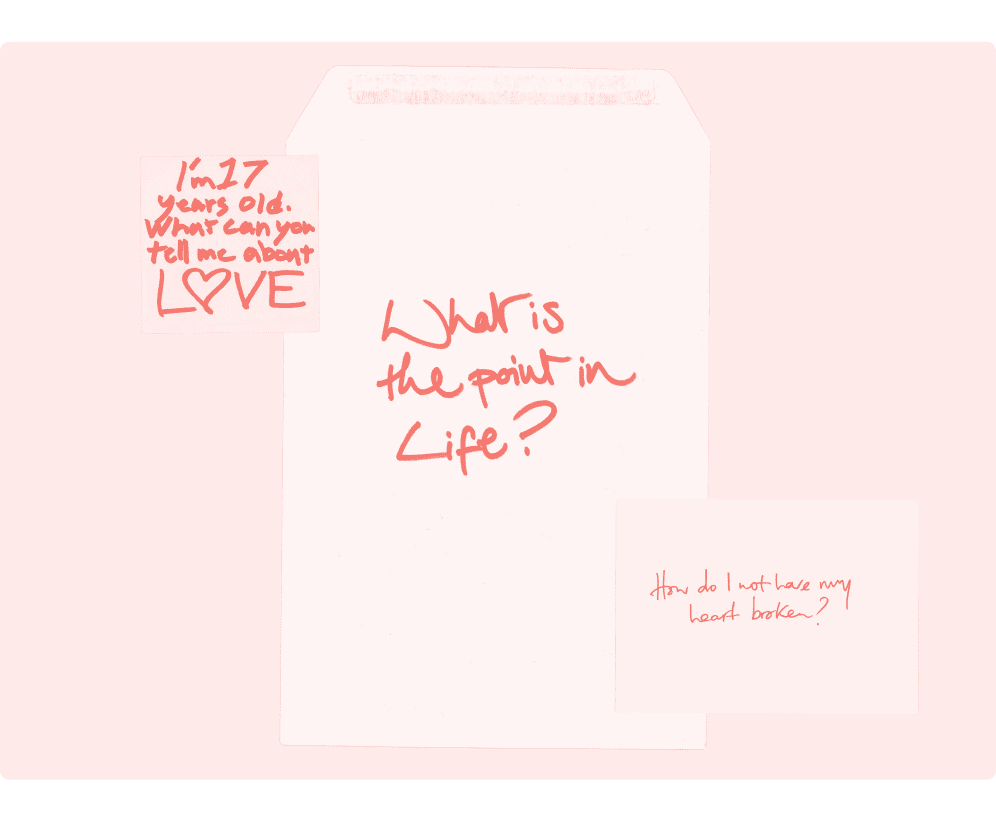
What is the point in life?
Dear Beau,
To understand the point in life we must first understand what it is to be human. It seems to me that the common agent that binds us all together is loss, and so the point in life must be measured in relation to that loss. Our individual losses can be small or large.
They can be accumulations of losses barely registered on a singular level, or full-scale cataclysms. Loss is absorbed into our bodies from the moment we are cast from the womb until we end our days, subsumed by it to become the essence of loss itself. We ultimately become the grief of the world, having collected countless losses through our lifetime. These losses are many-faceted and chronic, both monstrous and trivial. They are losses of dignity, losses of agency, losses of trust, losses of spirit, losses of direction or faith, and, of course, losses of the ones we love. They are daily, convulsive disappointments or great historical injuries that cast their shadows across the human predicament, reminding us of the stunning potential of our own loss of humanity. We are capable of the greatest atrocities and the deepest sufferings, all culminating in a vast, collective grief.
This is our shared condition.
Yet happiness and joy continue to burst through this mutual condition. Life, it seems, is full of an insistent, systemic and irrepressible beauty. But these moments of happiness are not experienced alone, rather they are almost entirely relational and are dependent on a connection to the Other—be it people, or nature, or art, or God. This is where meaning establishes itself, within the connectedness, nested in our shared suffering.
I believe we are meaning-seeking creatures, and these feelings of meaning, relational and connective, are almost always located within kindness. Kindness is the force that draws us together, and this, Beau, is what I think I am trying to say—that despite our collective state of loss, and our potential for evil, there exists a great network of goodness, knitted together by countless everyday human kindnesses.
These often small, seemingly inconsequential acts of kindness, that Soviet writer Vasily Grossman calls “petty, thoughtless kindness”, or “unwitnessed kindness” bind together to create a subterranean and vanquishing Good that counterbalances the forces of evil and prevents suffering from overwhelming the world. We reach out and find each other in the common darkness. By doing so we triumph over our collective and personal loss. Through kindness we slant, shockingly and miraculously, toward meaning. We discover, in that smallest gesture of goodwill laid at the feet of our mutual and monumental loss, “the point”.
Love, Nick
Excerpt from The Red Hand Files © Nick Cave 2022. Issue 204. Reprinted with permission from Nick Cave. All rights reserved. theredhandfiles.com
—————————
‘I’m 17 years old. What can you tell me about love?’ ‘How do I not have my heart broken?’
Dear Mauro and Jenny,
The surest way to avoid a broken heart is to love nothing and no-one—not your partner, your child, your mother or father, your brothers or sisters; not your friends; not your neighbor; not your dog or your cat; not your football team, your garden, your granny or your job. In short, love not the world and love nothing in it. Beware of the things that draw you to love—music, art, literature, cinema, philosophy, nature and religion. Keep your heart narrow, hard, cynical, invulnerable, impenetrable, and shun small acts of kindness; be not merciful, forgiving, generous or charitable—these acts expand the heart and make you susceptible to love—because as Neil Young so plainly and painfully sings, “Only love can break your heart.” In short, resist love, because real love, big love, true love, fierce love, is a perilous thing, and travels surely towards its devastation. A broken heart—that grief of love—is always love’s true destination. This is the covenant of love.
However, Mauro, to resist love and inoculate yourself against heartbreak is to reject life itself, for to love is your primary human function. It is your duty to love in whatever way you can, and to move boldly into that love—deeply, dangerously and recklessly—and restore the world with your awe and wonder. This world is in urgent need—desperate, crucial need—and is crying out for love, your love. It cannot survive without it.
To love the world is a participatory and reciprocal action—for what you give to the world, the world returns to you, many fold, and you will live days of love that will make your head spin, that you will treasure for all time. You will discover that love, radical love, is a kind of supercharged aliveness, and all that is of true value in the world is animated by it. And, yes, heartache awaits love’s end, but you find in time that this too is a gift—this little death—from which you are reborn, time and again. I have only one piece of advice for you both, and it is the very best that I can give. Love. The world is waiting.
Love, Nick
Excerpt from The Red Hand Files © Nick Cave 2022. Issue 177. Reprinted with permission from Nick Cave. All rights reserved. theredhandfiles.com
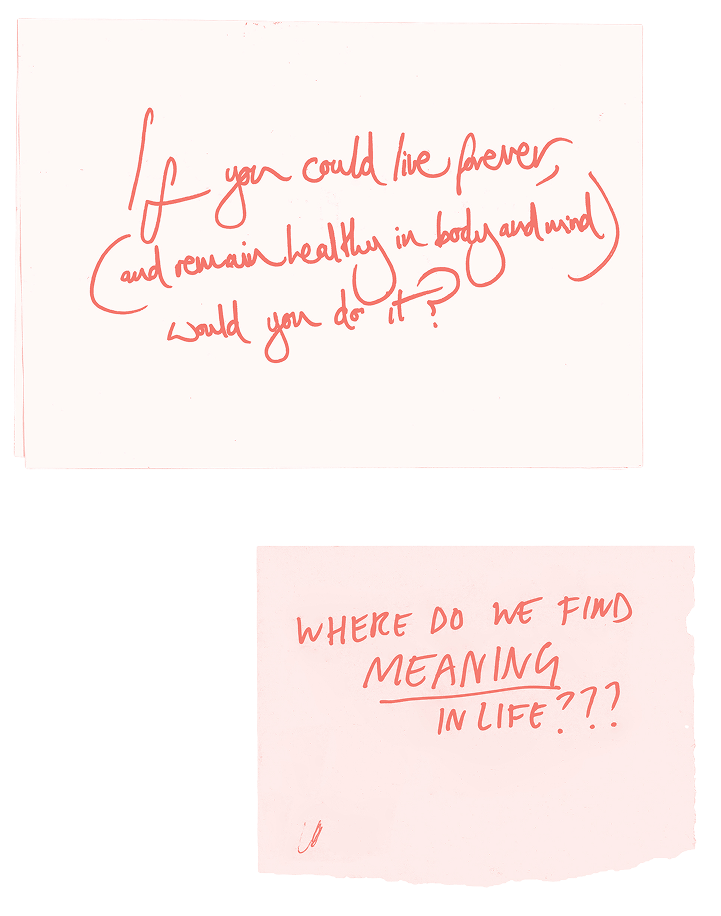
‘If you could live forever (and remain healthy in body and mind) would you do it?’
‘Where do we find meaning in life?’
Dear Elise and Assaf,
Susie has hung a cuckoo clock in the garden of our house in London. Behind the house there is a primary school, obscured by a high, ivy-covered wall, and each day we hear the sounds of children playing. To the side of the house, across the lane, is a church. The church is forever tolling its bell. Right now everything seems to be happening at once. The crazy cuckoo clock marks out time—cuckoo! cuckoo! cuckoo!, the children scream in the schoolyard, and the bells from the church ring forth, promising us everlasting life. I sit here with my wife, two people placed within this cosmic drama, drinking coffee, absorbed in our separate temporary worlds—right now hers is Instagram and mine is answering your questions.
Elise, you asked if I would live forever if I could, well, the answer must be no. I wouldn’t because, as far as I can see, the meaning of life is nested within the set terms of our own mortality. “Forever” is both incomprehensible and utterly meaningless. I don’t believe we live just for the sake of it; rather we live our lives within the poetry of our own demise, within our own time, and our own limitations, and for that very reason alone we do so meaningfully. We work, we love, we care for each other, and we suffer together, knowing that one day we will die. The children in the schoolyard run headlong toward adulthood and their own disappearance, and we adults are the living breathing reminders of that. The man who waves at me as he walks his dog up the lane will die, as will the people filing into the church at the ringing of the bell, and the shop assistant hurrying to work, and the parking inspector, and the street sweeper, all will die in time—oh, and the squirrel (ah, there he is), he too will die (ouch), and the flowers, the swaying trees, and the earth itself. It is toward this temporal inconvenience—our finitude—that we move, with only a few precious moments to add value to this world. What can we do in this time that we are given, that is running through our fingers, even now? How can we lighten our mutual predicament that is drawing ever closer? Assaf, there lies the meaning in life—it is in the expansion of ourselves, in our benevolence, to fully occupy our allotted time.
And so the cuckoo stops cuckooing, and the little wooden bird retreats to await the next hour, the children have gone back to class, and the church bells fall silent as those inside kneel and pray, and the startled sunlight catches the side of my wife’s face with sudden purpose.
Unaware, she scrolls and scrolls.
Love, Nick
Excerpt from The Red Hand Files © Nick Cave 2022. Issue 182. Reprinted with permission from Nick Cave. All rights reserved. theredhandfiles.com
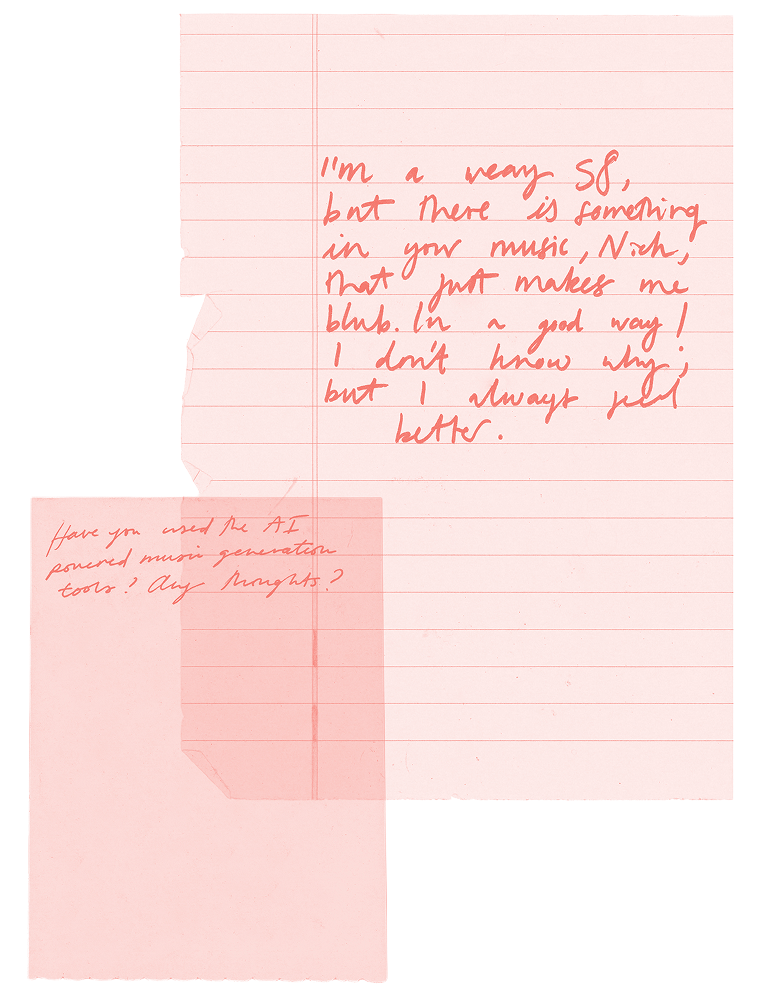
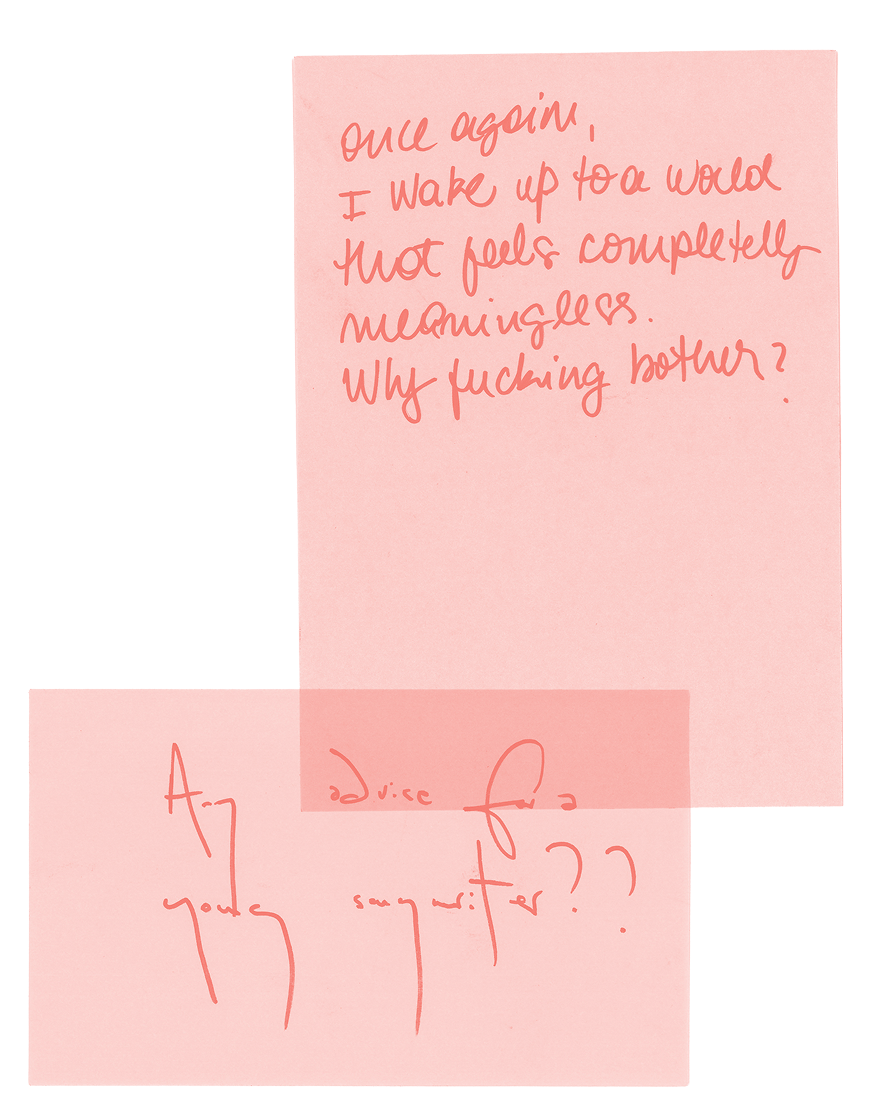
‘Once again, I wake up to a world that feels completely meaningless. Why fucking bother?’
‘I’m a weary 58, but there is something in your music, Nick, that just makes me blub. In a good way! I don’t know why, but I always feel better’
‘Have you used the AI powered music generation tools? Any thoughts?’
‘Any advice for a young songwriter?’
Dear Leonie, Diego, David and Marshal,
Among the hundreds of questions sent to The Red Hand Files each week, a few recurring themes emerge. Some of the letters, like yours, Leonie, are steeped in a sense of demoralization and futility. “This world has no meaning or value, why bother?” they ask. They reflect a common existential attitude, characterized by a disaffection towards the world and a near-total depletion of any sense of meaning. Yet there is another repeating, more positive, theme that runs parallel to this sentiment—one that speaks of music as one of the last sources of solace and comfort for these disheartened individuals. “Thank God for music,” they say, “I don’t know what I’d do without it!”
I believe we value music so highly partly because when we listen to certain songs we perceive, on some level, the inherent human battle waged within them—the struggle of the songwriter and their triumph over that struggle.
These songs reassure us by addressing the soul and spirit—concepts that have been almost entirely stripped from this materialistic, secular and degraded age. We weep, laugh, and dance not just because of the song’s rhythm or melody, but because in the music we recognize the struggle intrinsic to the act of creation and the sheer life-affirming audacity of creativity itself, that most elemental of human impulses. These songs speak in a language of inspiration and hope, telling us that we can overcome the many troubles and disillusions we face. Through their very existence, they show us that beauty and goodness can prevail.
So, as a songwriter, David, I find myself despairing over the rise of AI song generators. It’s not that they aren’t good, in fact they are—or soon will be—too good. Before long, they will be able to produce songs indistinguishable from those created by humans. And this is what grieves me. They will be identical in presentation, perhaps even superior, but entirely devoid of soul, cynically undermining the need for matters of the spirit, the sacred, the divine. “What is the purpose of the soul?” they scorn. “What is its material use?” These are the questions that ring out like a final hollow bell tolling at the end of a civilization, where the last threads of meaning have been severed and discarded. Notions of artistic struggle, of striving, of triumph over adversity, personal pride, desire, delight, inspiration, and resilience are dismissed as mere obstacles or indulgences on the way to the new and gleaming product—the AI-generated song, perfect in its cynicism, magnificent in its emptiness.
I often wonder why musicians don’t seem more alarmed by the rise of these songwriting generators. But perhaps I am hopelessly out of touch with how the world functions, and don’t fully understand the immense positive potential they may offer. No doubt there is some truth to this, but at the same time I believe we musicians and songwriters are sleepwalking into a situation where we allow this technology to strip the world of one of the last genuine transcendent experiences left to us—man-made music—by surrendering our souls to a machine. What does this say about us, that we so passively acquiesce? Are we not the valiant knights, the truth-tellers, the beauty-makers, who journey to the dark side, slay the dragon, and bring back the dripping treasure? Are we not the guardians of the world’s soul?
You have embarked on a noble path, Marshal, and my advice to you is to fully offer up your messy, broken, limited, disastrous human self to the act of creation, and through that eternal alchemical sleight of hand, write a song that is new, beautiful, and awe-inspiring. And then go and do it again. Become the all-singing, all-dancing, all-human answer to this most dark and demoralized question: “This world has no meaning. Why fucking bother?”
Love, Nick
Excerpt from The Red Hand Files © Nick Cave 2026. Issue 359. Reprinted with permission from Nick Cave. All rights reserved. theredhandfiles.com
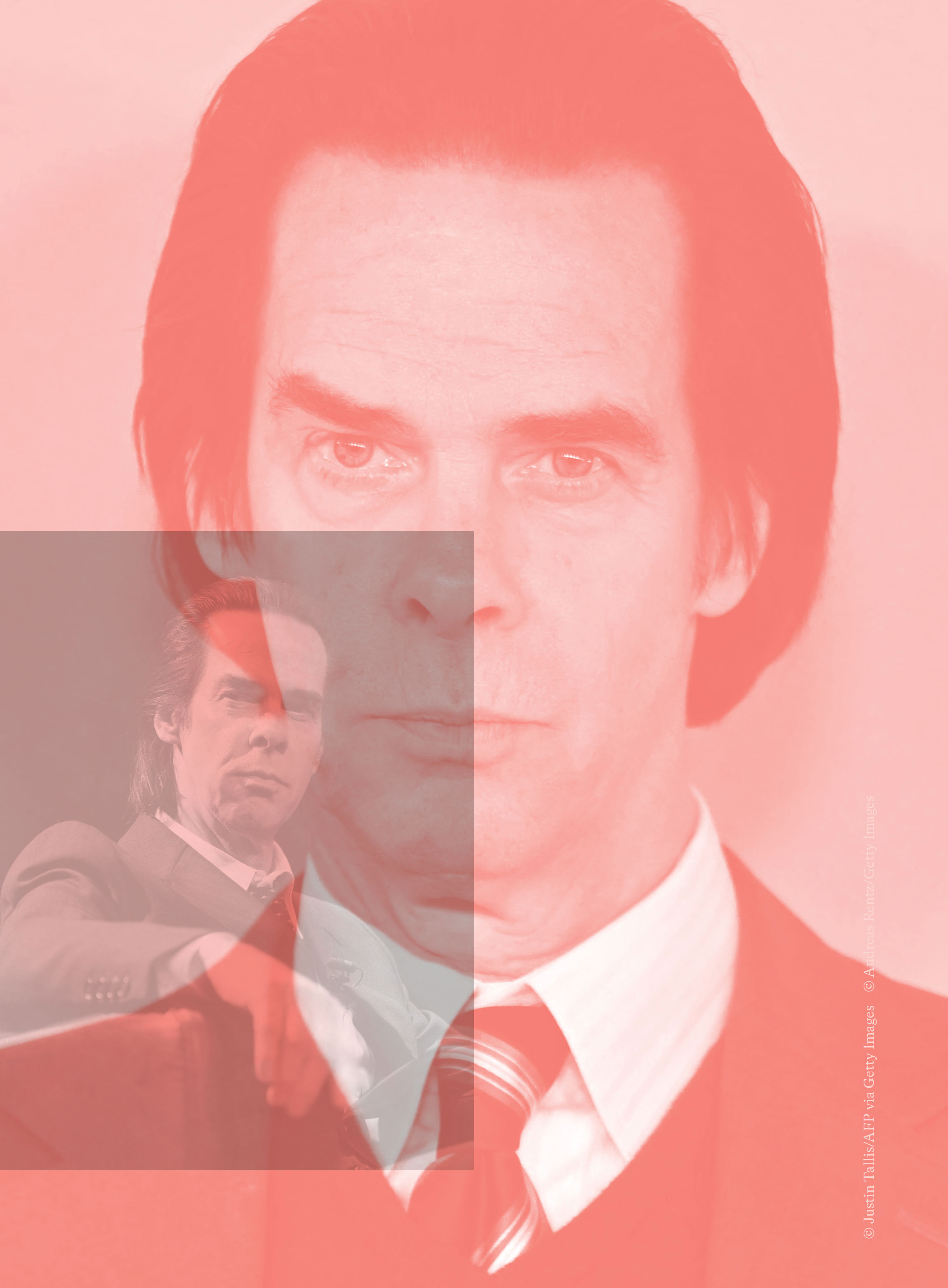
*Nick Cave Portrait: Justin Tallis/AFP via Getty Images and by Andreas Rentz/Getty Images
Related Articles
Amy Kurzweil on the value of creative process
Writers agree: AI isn’t a novelist. So why is this author interested?