Finding meaning in AI art through scholar’s rocks
Faced with a glut of synthetic content, novelist Ken Liu finds an unexpected artistic possibility in a Chinese tradition of collecting and shaping unusual stones.
00:00 – 00:15 | The Orphan Hacker
Visual: We open on a high-contrast shot of a sleek, black server rack in a dim suburban basement. A young woman, Julia Z, sits with her back to the camera, illuminated only by three minimalist, glowing monitors. A single, stylized “Z” hacker signature dissolves onto the screens. Suddenly, the image violently fractures with high-stakes data visualization graphics. The lighting transitions sharply from cozy domestic warmth to a prestigious, tension-heavy digital thriller palette.
…
This is an AI-generated “trailer script” for my novel, “All That We See or Seem.”
Oh, no, I didn’t ask an AI to do this. Every day, I receive a dozen or so emails from scammers promising me the moon if I use their book marketing services. The above is an excerpt from one of them.
The AI-generated text is too humanlike to be caught by the spam filter, but I struggle to make sense of it: What is a “stylized ‘Z’ hacker signature”? What is a “minimalist” monitor? And wouldn’t three of them, in any event, defeat minimalism? How could said minimalist monitors and sleek computer server racks be said to yield “cozy domestic warmth”? (Actually, maybe for an AI, that is cozy domestic warmth . . . )
And, worst of all, I feel like I’ve wasted my time. The scammer didn’t even bother to write this slop. They simply wrote (or even more likely, asked the LLM itself to bootstrap-write) a prompt that told the model to go out and scrape the blurbs of newly released books and create a 1,000-word sales pitch and trailer script for each, tailored with whatever praise the model could find online that it thought would flatter the author and get them to open their wallet.
Conversations at the frontier, in your inbox
SubscribeCheap, artificial cognition, like debased currency, has been used to occupy my attention and steal my time—my most precious resource.
Unfortunately, this problem is going to get worse. The promise of AI is abundance: abundance of intelligence, of problem-solving, of knowledge, explanation, skill. But the shadow of abundance, its evil twin, is glut: an excess supply of imitation wit, flimflam gab, the appearance of thought. We’re flooded with a glut of things that look like attempts at communication, works of art or things with meaning but are fundamentally simulated attempts at meaningful communication, designed to steal our attention.
How can we make art that benefits from the abundance AI provides without falling prey to the glut? This is one of the defining questions for artists in our age.1
The first solution is to simply ignore AI. Mechanization does not automatically render human craft obsolete. Painters did not disappear after the invention of the camera. Handicraft is more appreciated today because mass production is so common. We don’t need to make AI a part of every practice in our lives, any more than we need to give our toaster or refrigerator an IP address.
But that cannot be the only path. We are a technological species, and our own humanity has always been refracted and expressed through our technological practices. Art is inseparable from the tools we use to make art. After all, the camera, a mechanical device, is the foundation of multiple humanistic art forms: photography, cinema, even the short-form videos that have become the dominant modern cultural medium. Why can’t the abundance of AI, like the camera, enable new artistic practices?
I can see, at the present, at least three ways in which AI may be interesting to a human artist.
The first mode involves AI as a mirror. This is the mode in which the consumer and the artist merge into one, via a practice I call “Scheherazade narratives,” wherein AI allows the user to fantasize in a solipsistic mode.2 The second mode involves AI as a new artistic medium, wherein artists are given the affordances and tools to train and shape their own models and to direct their generation far more precisely than is presently possible.3 In both of these modes, authorship is assumed to be unproblematic. But what about the more common case at present, a third mode, where an AI-generated passage or image has no clear human author, only a human prompter?
An artist interested in crafting art through generative AI today faces the frustrating reality of insufficient control. The most you can do as an artist is to describe—in excruciating detail—to the model what you want to see, and hope the model can make it for you. But, as every artist knows, telling someone to do something is not the same as doing it. Natural language—as embodied in the chat interface—simply does not give you enough control over the final result to claim authorship, no more than someone who tells an artist what to draw or gives a novelist an “idea” can legitimately claim to be a painter or novelist. Indeed, this is why the U.S. Copyright Office explicitly denies copyright to those who merely prompt a model.4
Yet the fact that something is uncopyrightable doesn’t mean it cannot be art.
Yet the fact that something is uncopyrightable doesn’t mean it cannot be art. The constraint—that one cannot control how the machine processes the prompt with precision, and that prompting is all one has—itself seems to invite new modes of artistic creativity.
How do we make art when the human artist can’t claim to be the author? Recently, a possible answer came to me from a most unexpected place: scholar’s rocks.
There is a centuries-old Chinese aesthetic tradition of collecting, displaying and appreciating rocks. The English term “scholar’s rock” doesn’t correspond to a single Chinese category; rather, it encompasses several related but distinct traditions, such as gongshi (供石, “offering rock”), qishi/guaishi(奇石/怪石, “strange rock”), lingshi (灵石, “numinous rock”) and so on. In practice, collectors generally prize rocks with unusual features or qualities, from bits of fossilized wood displayed on desks to the perforated, eroded limestone of Taihu (Lake Tai) showcased in Chinese gardens. Taihu stones, in particular, with their famed qualities of shou (瘦, “leanness”), zhou (皺, “wrinkled texture”), lou (漏, “leaky perforations”) and tou (透, “airiness”), have become most associated with the concept of scholar’s rocks in the West. These rocks are collected and traded much like works of fine art. They even have their own critical tradition, including treatises and essays on how to appreciate them.5
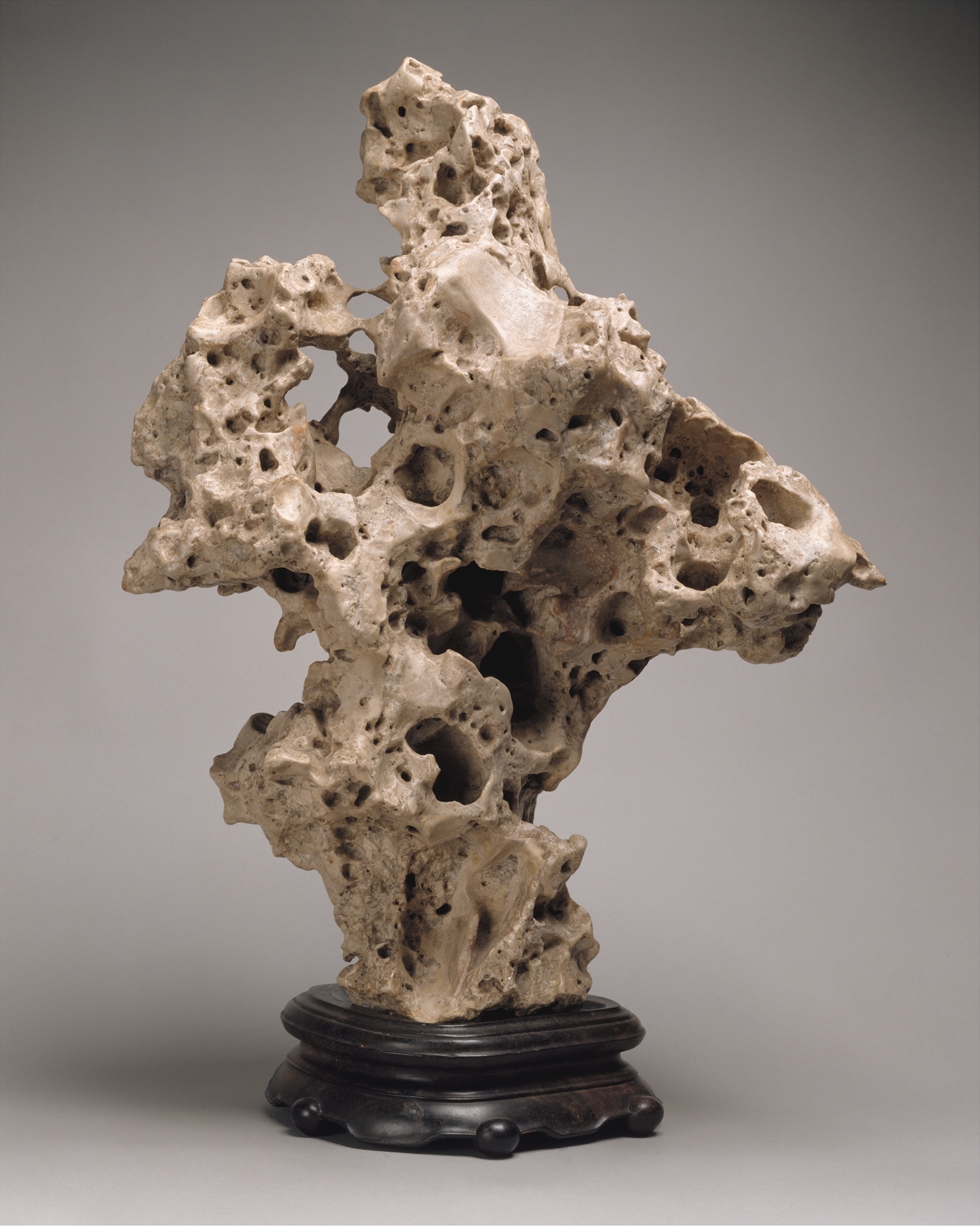
“Scholar’s Rock.“ China, Qing dynasty, 19th century. Limestone, wood stand. The Metropolitan Museum of Art, accession no. 2008.674a, b. The Met Open Access, public domain, CC0 1.0 Universal.
For a long time, I understood the aesthetic appeal of scholar’s rocks to be delight and awe in the creative potential of nature itself, without reference to human art. When contemplating a scholar’s rock, the viewer’s interest isn’t in the choices made by a human author, but in texture and form, the traces and prints of erosion, weathering and geological forces over eons.
Here’s Kong Chuan (孔傳), writing in the preface to “Yunlin shipu” (《雲林石譜》), a catalog of types of scholar’s rocks, in 1133:
Even if but the size of a fist, a rock may contain the beauty of a thousand cliffs. Larger rocks may be found in gardens and halls; smaller ones are displayed on tables and desks. Observing them is like observing Mount Song and Mount Shaoshi, or being in the presence of Mount Gui and Mount Meng. Clear thoughts arise in the mind as soon as one sits before them. 6
Recently, however, I found out I was mistaken.
Later in “Yunlin shipu,” Du Wan (杜綰), the author, says the following concerning the production of Taihu rocks:
With great effort, scouts dive deep into the lake, wielding mallets and chisels to search for strange, uncanny rocks on the lake floor. To harvest the rocks, they chisel off pieces, run thick cables through the perforations and then winch them out of the water with the aid of frames erected over large boats. If some piece shows an especially interesting or craggy form, then the scouts chisel it to enhance the form and sink the rock back into the lake, such that over time, water and wind may continue to scour it until the form and texture come alive, indistinguishable from nature (“石理如生”).7
Taihu rocks are art.
The artfulness of Taihu rocks is deeper than the trivial sense in which all forms of beauty in nature are artful because they are the result of human aesthetic judgment and human choice (e.g., El Capitan is not merely a natural rock formation, but also an idea, a name, a set of human choices to contemplate and view and paint and photograph and tell stories about that rock formation). Taihu rocks are also deliberately trained and shaped: There is literally a human artist who uses a chisel and mallet to shape the rock into its final form.
However, not all human shaping of scholar’s rocks is desirable. Du Wan describes another kind of collectible rock, found in Hukou in Jiangzhou. These come in two varieties: One is blue-green, with specimens resembling mountain peaks or other objects; the other has the texture of brushed silk, is perforated throughout and gives off a sonorous ring when tapped. While Hukou stones were much prized by connoisseurs like Su Dongpo (蘇東坡), the great Song dynasty poet, Du Wan tells us that local entrepreneurs, in a move that anyone who has been to a popular tourist destination would find familiar, decided to “improve” nature by gluing and lacquering onto the stones pebbles and broken bits of other rocks, creating artificial “scenes” that left viewers with the impression of heaped offering plates before statues of the Buddha, “devoid of flavor or meaning” (“殊無意味”).8
One is an act of deception; the other is an attempt to discover.
What separates the kitschy, vulgar Hukou stone diorama landscapes from trained Taihu rocks if both are shaped by human artifice? It’s in the human shaper’s orientation to the material. In the first, the human shaper forces the stone to wear more bits and pieces to pretend to be something it is not and fit into the mold of a cliché. In the second, the scout follows the rock, wielding chisel and mallet to enhance its natural uncanniness, and the scout’s craft ultimately disappears, merging with living nature. One forces the material to bear a (boring) meaning already decided upon; the other converses with it, letting it lead the (uncanny) way. One is an act of deception; the other is an attempt to discover.
Following the rock’s lead is crucial here. Scholar’s rocks are appreciated precisely because they don’t display human beauty; instead, as Su Dongpo puts it, “The plum is cold and thus elegant; the bamboo is thin and thus long-lived; the rock is ugly and thus patterned and meaningful.” (“梅寒而秀,竹瘦而壽,石醜而文”).9
I find the concept of the rock-scout deeply evocative for artists in the age of generative AI.
Rocks and generative models alike do not create meaning through intention—there is no there there.10 In both cases, the meaning must be drawn from the material (rock, AI-generated text or image) by the humans involved in the aesthetic interaction: the guide (the rock scout, the prompter) and the audience. In the case of the scammer emails and the Hukou dioramas, humans use the material crassly to (cheaply) imitate something real (the personal interest of a reader who has read and enjoyed a book, a true scene from nature) to capture the audience’s attention. This is why the audience finds the result devoid of meaning and flavor. In the case of the Taihu rocks, however, the rock scout tries to understand the nature of the rock and to draw it out through restrained shaping. As such, it is a genuine act of creation, not merely a shortcut via deceptive imitation, and the meaning is perceived by the audience in contemplating this deeply nonhuman object framed by the scout’s perception, selection, attention and, above all, training.11 Properly understood, Su Dongpo’s aphorism is closer to “the rock is ugly and thus capable of pattern-making and meaning-making by the scout and the audience working together.”
What is the equivalent of Taihu rocks in AI art?
In “Apocryphal Inventions,” typeface designer Jonathan Hoefler uses generative AI to dream up images of impossible machines. From the project description:
The objects in the Apocryphal Inventions series are technical chimeras, intentional misdirections coaxed from the generative AI platform Midjourney. Instead of iterating on the system’s early drafts to create ever more accurate renderings of real-world objects, creator Jonathan Hoefler subverted the system to refine and intensify its most intriguing misunderstandings, pushing the software to create beguiling, aestheticized nonsense.12
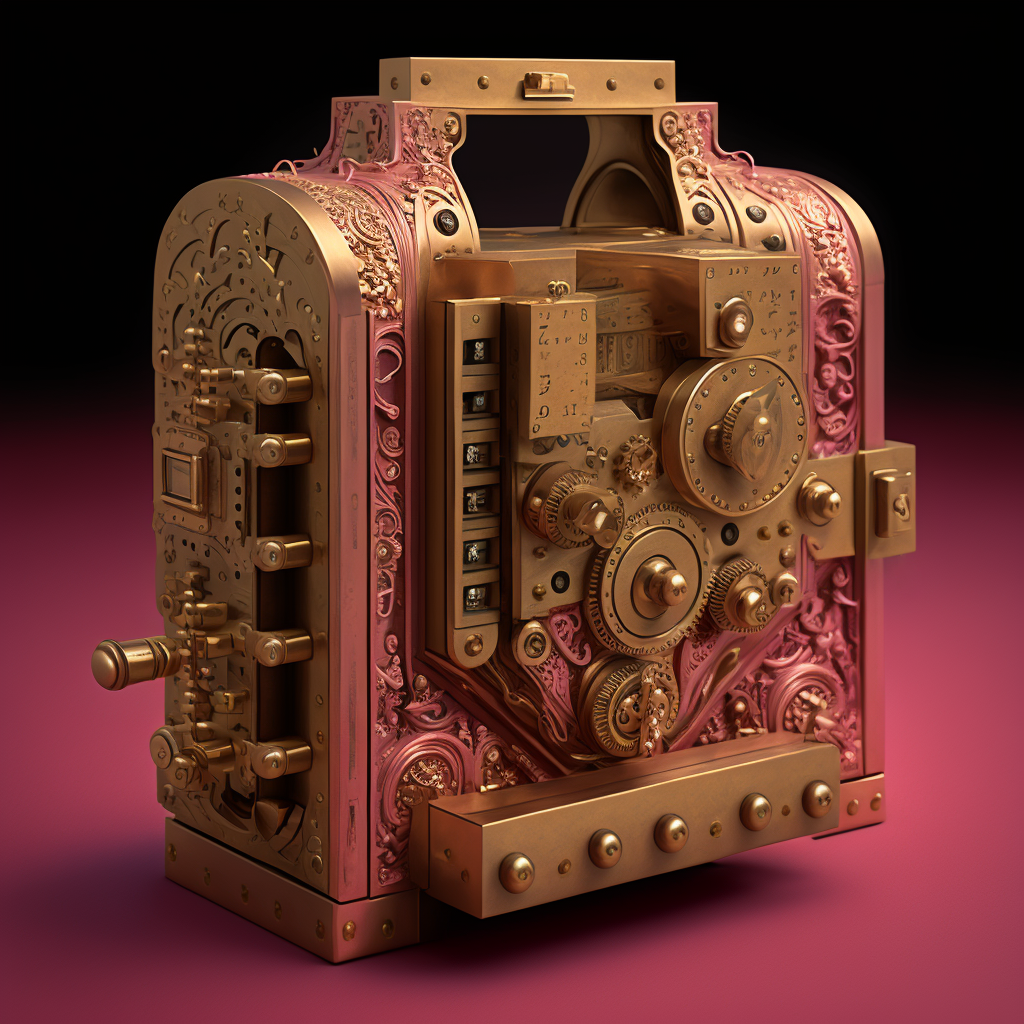
An apocryphal invention: “The ‘Mystical Vaults of Qiang-Shen.’” jonathanhoefler.com/inventions/the-mystical-vaults-of-qiang-shen
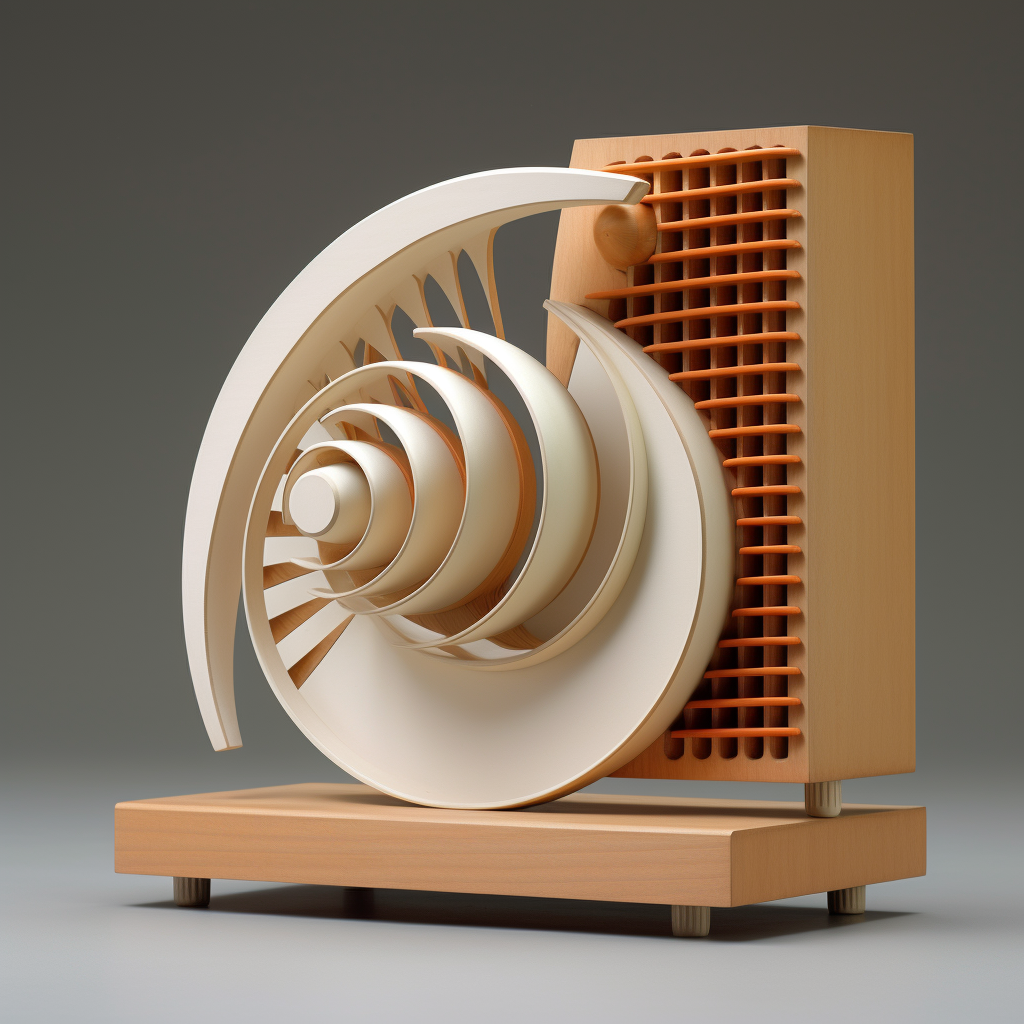
Another apocryphal invention: “Mansplaining Sound Scrubber.” jonathanhoefler.com/inventions/sound-scrubber
The renderings are filled with AI-isms: almost-gears that don’t mesh, springs that melt and drip, symbols that meander between sense and chaos (“HIOG[unreadable][unreadable]OMR”). Yet the overall effect is great whimsy, charm and flavor. There is a playfulness to these machines that reminds one of toys, movie props or the kinds of gadgets one might see in a retro sci-fi show that crosses “Mad Men” with “The Jetsons.” By leaning into the uncanniness of generative AI in successive generations, amplifying its eerie naïveté and “errors” and not asking it to pretend to be human, Hoefler trained and enhanced the forms made by Midjourney, leaving us with something genuinely new.
To further round out the project, Hoefler titled the apocryphal inventions and confabulated histories for each of them, and these compositions, entirely authored by him, often have nothing to do with the prompts that generated the images in the first place. Like the rock scout, Hoefler follows the model’s lead, naming and titling them after generation.

“Chromatic Telegraph.” jonathanhoefler.com/inventions/chromotelegraphic-machines
“An iris indexer, to ensure matched colors in the manufacture of prosthetic eyes.” And there it is: a smiling robotic face with two colorful eyes, along with many more artificial eyeballs on radiating stalks, an Argus Panoptes born from latent tensors and the scouring of diffusion flows. Hoefler’s confabulations have fully merged into the living flow, the qi, of the model.
Or consider “White Dust from Mongolia,” a series of AI-generated short prose poems curated by Hao Guang Tse, poet and editor. Inspired by the title of an unfinished film project by the deceased poet Theresa Hak Kyung Cha, Tse fed “White Dust from Mongolia” as a prompt into the open-source model GPT-J and curated the resulting generations for the most interesting bits. Crucially, Tse realized from the very start that asking the LLM to “complete” Cha’s unfinished work—similar to asking the AI to make up a trailer script for a novel, an attempt to direct the AI to fill in a prefabricated shell of meaning—would have been undesirable and impossible. Instead, Tse limited the length of generations and turned up the temperature on the model, pushing it to be “wilder in its utterances.
White Dust from Mongolia: an innocent journey is a deadly film
… But an elderly man wearing a long dark overcoat sits in a corner and falls asleep with the help of a bag of drugged water. By the credits, the man, who is given no name, is still wailing and waking up in a dark chamber devoid of light. In Buryat, Yakut, Ukranian [sic] or in Mandarin, the characters repeat, “We are leaving. We are leaving. We are entering. Time to enjoy and time to eat and time to leave.” They miss Mongolia entirely.13
The human shaping, which takes effort, fades away because the model is allowed to exhibit its grain, and the grain is the point.
Once again, the result is replete with AI-isms: illogical scenes, incoherent narrative turns, odd phrasings (“a bag of drugged water”), purposeless repetition. And yet the overall feeling is not the soulless desperation to please found in the generated Julia Z “trailer script,” but an irreducible strangeness that invites the reader to engage with the uncanny. The human shaping, which takes effort, fades away because the model is allowed to exhibit its grain, and the grain is the point. “They miss Mongolia entirely.” That one line—an extended contronym, a Janus sentence, capable of two irreconcilable readings like “The Dress”—is inhuman and becomes meaningful through Tse’s selection and framing and the reader’s attention.
I want to end with an extended quote from Su Dongpo. An iconic literary figure, Su Dongpo delighted in the beauty of strange rocks. In the essay “Guaishi gong” (《怪石供》, “An Offering of Strange Rocks”), written in the year 1082, Su Dongpo describes his delight in scholar’s rocks through a most idiosyncratic tale:
What are guaishi (“strange rocks”)? Near the Qi’an River, one can often find beautiful rocks indistinguishable from jade. Red, white or blue, the patterns in these rocks remind me of fingertip whorls, so intricate and lovely that even a skilled artist cannot match them with art. … Beauty and ugliness emerge only through comparison; I cannot claim to know their true origins. Indeed, if all the rocks in the world were like these, ordinary rocks would be deemed guaishi instead.
I’ve heard rumors of a place beyond the ocean where, instead of speech, people communicate through shapes. Rather than resorting to words, they converse via forms, far faster than speaking. What a marvel! Isn’t that like the way nature’s shaping, complete in an instant, feels like art to us?
Children of Qi’an, while bathing in the river, often pick up guaishi. I offered these children sweet cakes for their findings. In this manner, I gathered 298 guaishi. The larger ones were about an inch across, the smaller ones like jujubes or water chestnuts. One rock was shaped like a tiger, with a mouth, nose and eyes, so I made it the leader of the rock pack. The rocks sparkled delightfully after I put them in a copper basin, filled with water.
Chan Buddhist Master Foyin then sent a messenger to me, and I sent the rocks to him as an offering. For the great Chan master, everything in the cosmos is seen through the eye of the Way, and all is Emptiness. Since, to him, pearls and jade are no different from broken roofing tiles and gravel, I hope he will accept these guaishi, bathed in water, and indulge me with a smile.14
I can’t help but think that somehow, nearly 10 centuries ago, Su Dongpo glimpsed a vision of our generative AI future, when our words, our paintings, our sculptures, our crafts—vast quantities of our externalized creativity—have been captured and embedded into mathematical forms in multidimensional space, within which the flow of capitalism and desire takes craggy, awkward, strange shapes instantaneously, and we mistake it for art.
Generative AI models are not nature; they are engineered systems that capture statistical information about human creations reduced to vectors. Their very existence is not “natural,” but the result of capitalism, labor and a congeries of social, cultural and technological forces converging in this moment. Yet, given these complex systems with emergent features, we need to explore and understand their aesthetic properties so we don’t fall prey to the beguiling temptation to use them for mere imitation, offering up slop devoid of meaning and flavor.
Instead of worshiping at the altar of AI or fretting about the threat of glut, we should be trading sweets with our own childish hearts, gently guiding the machine to produce uncanny offerings to Emptiness, scouting a path to the country of forms from which alien meanings are only just emerging. In good AI art, we contemplate the strange future that is shambling toward us from out of the fog.
AIrtifice is ugly and strange, and we should lean into those qualities rather than try to sand them away. In striving to perceive the patterns in the uncanny, we make it meaningful.
Notes
1 There are many other questions: how should we think about the consent of artists whose work is incorporated into these models? What role, if any, does copyright play in this? What about the environment? While all of these questions are important, this essay will focus on only the narrow one posed in this paragraph.
2 See, for example, Neel Gupta, Maria Antoniak and Melanie Walsh, “AI Fiction in the Wild,” arXiv, revised June 23 2026, doi.org/10.48550/arXiv.2606.22748. One might be reminded of Annie Wilkes, from Stephen King’s Misery, who kidnaps her favorite novelist so that he can write a novel just for her. Luckily, no human novelist will be hurt when AI is involved.
3 I explore the potential of AI as a brand new medium for art in this mode more fully elsewhere. Ken Liu, “The Cinematograph, the ‘Noematograph,’ and the Future of AI Art,” Big Think, April 8, 2025, bigthink.com/high-culture/ken-liu-ai-art.
4 “The Office concludes that, given current generally available technology, prompts alone do not provide sufficient human control to make users of an AI system the authors of the output. Prompts essentially function as instructions that convey unprotectible ideas.” U.S. Copyright Office, Copyright and Artificial Intelligence, Part 2: Copyrightability, Jan. 2025, copyright.gov/ai/Copyright-and-Artificial-Intelligence-Part-2-Copyrightability-Report.pdf, p. 18.
5 References to rocks being collected/displayed as aesthetic objects date back to the late 5th century, but the earliest surviving reference to what we would think of as scholar’s rocks appears in Bai Juyi (白居易 ) in 826 C.E., when he writes of acquiring a pair of “strange and ugly stones” from Taihu and drinking with them as their “third companion” (“Twin Stones”《雙石》). Bai Juyi 白居易, 〈雙石〉, in “Quan Tang shi”《全唐詩》卷四百四十四, Chinese Wikisource, zh.wikisource.org/zh-hant/雙石,.
6 Kong Chuan 孔傳, 〈雲林石譜原序〉, preface to Du Wan 杜綰, “Yunlin shipu” 《雲林石譜》, 四庫全書本, Chinese Wikisource, zh.wikisource.org/zh-hant/雲林石譜_(四庫全書本). All translations from Classical Chinese by the author.
7 Du Wan 杜綰, “Yunlin shipu” 《雲林石譜》卷上, 〈平江府太湖石〉 and 〈湖口石〉, 四庫全書本, Chinese Wikisource, zh.wikisource.org/zh-hant/雲林石譜_(四庫全書本)/卷上.
8 殊無意味 can suggest lacking charm, savor, interest—I use “meaning” here to emphasize the aesthetic dimension.
9 The quote is from Luo Dajing 羅大經, Helin yulu《鶴林玉露》甲編卷一, Chinese Wikisource, zh.wikisource.org/zh-hant/鶴林玉露/甲編/卷一. “文” can mean, among other things, “pattern,” “culture” or “refinement”—I use “meaningful” here to emphasize the meaning generated from the aesthetic savoring of patterns.
10 The training materials for AI models do embed authorial intention, but that isn’t at issue here.
11 The aesthetic ideal of Taihu rock training by scouts is that the human effort should fade away and become indistinguishable from nature itself. This should not be taken as my endorsement of the view that the labor of artists who shape and guide AI generation should be ignored or unacknowledged. An aesthetic ideal is not the same as an ethical guideline.
12 All images and quotes from Hoefler are used with his permission. jonathanhoefler.com/inventions.
13 All quotes used with the author’s permission. goodpress.co.uk/products/white-dust-from-mongolia-by-hao-guang-tse.
14 Su Shi 蘇軾, 〈怪石供〉, in “Dongpo quanji” 《東坡全集》卷一百, 四庫全書本, Chinese Wikisource, zh.wikisource.org/zh-hant/東坡全集_(四庫全書本)/卷100.