
Issue 02
November 2026
Abundance & Scarcity

02
On the eve of abundance: Yuval Noah Harari and Mustafa Suleyman on AI
A historian and a technologist discuss a future of vastly greater intelligence, and whether it will help us understand ourselves or make the world harder to comprehend.

03
Garry Tan on staying above the AGI line
As software becomes easier to build, the scarce skills move elsewhere: knowing what should exist, recognizing what works and understanding what people want.
04
Philippe Aghion: AI’s growth potential depends on competition
New technology can open the door to innovators or entrench the companies already in charge. The economist explains why his optimism depends on the institutions we build.

05
Tyler Cowen on the AI gains GDP misses
More free time, better services and fewer wasted purchases can make us wealthier without showing up in the headline numbers.
06
Poetry, algorithms and the words we inherit
Poet Sasha Stiles traces the systems that carry words between people and generations, asking where machine-generated expression belongs in that inheritance.

07
Finding meaning in AI art through scholar’s rocks
Faced with a glut of synthetic content, novelist Ken Liu finds an unexpected artistic possibility in a Chinese tradition of collecting and shaping unusual stones.

08
Abundance is no guarantee of a resilient society
Two centuries of extraordinary growth have taught us to expect more. Aaron Bastani asks whether that expectation has left us unprepared for disruption.

09
A richer economy won’t be enough to win trust in AI
Harvard professor Stefanie Stantcheva examines how people judge technological change: through their own experience, their expectations of fairness and what happens to those who lose out.

10
In-Between
The photographs published here are drawn from several bodies of work, exploring the sublime in the everyday, in-between moments, and the uncanny.
11
Mariana Mazzucato: Who benefits from AI abundance?
Public investment and shared resources underpin the technology. The economist argues that how we account for those contributions should change who shares in the returns.
12
Basic income as a right to shared wealth
Guy Standing argues that economic security should rest on a common inheritance, not the generosity of technology companies or predictions of a world without jobs.
13
When AI knows better, who gets the last word?
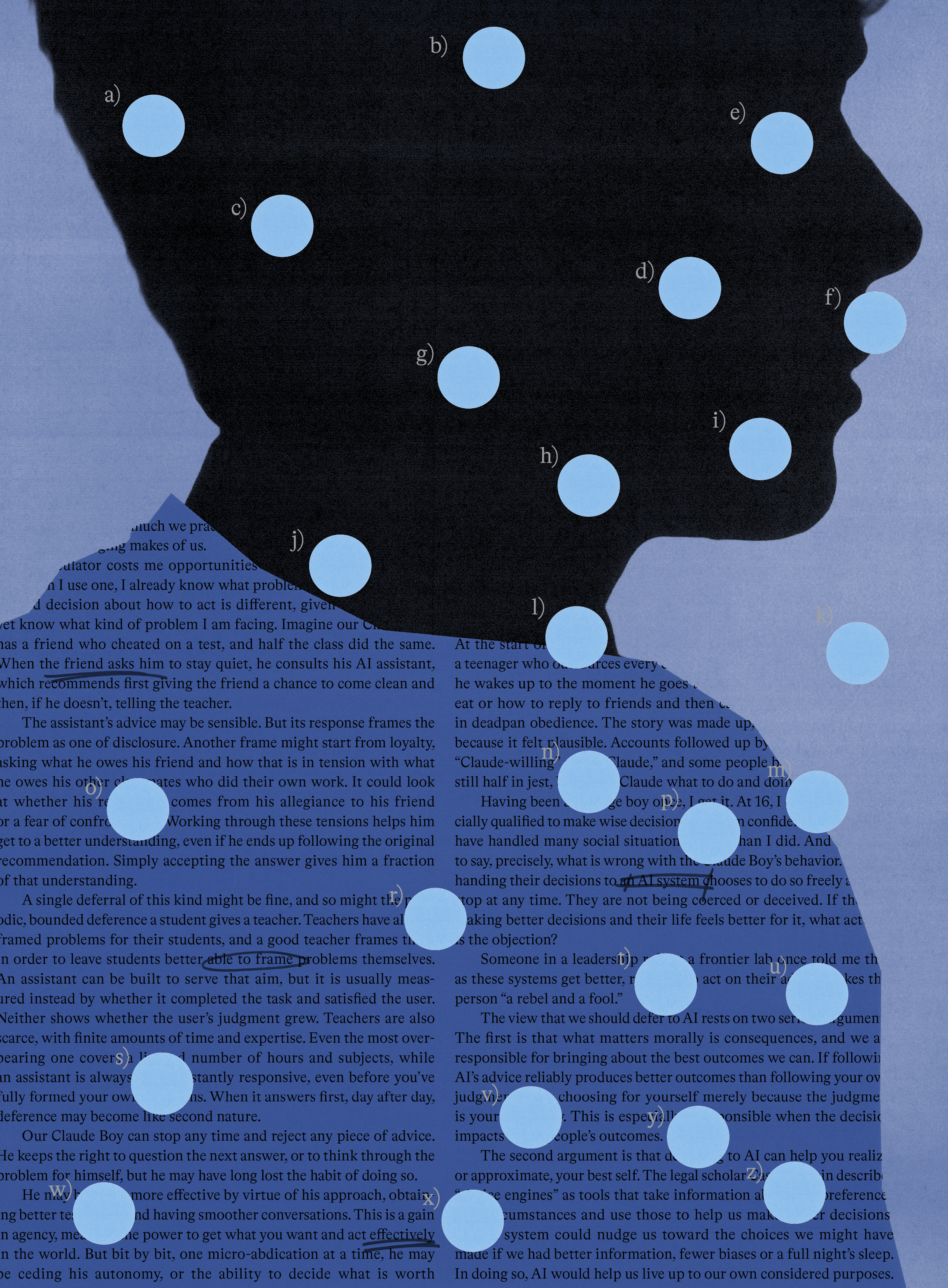
Following an assistant’s advice can make life easier. Brendan McCord asks what happens when choosing for ourselves becomes a habit we no longer practice.
14
Holly Herndon on making art in an age of infinite media
From a choir that trains a model to a parliament of people and agents, the artist builds spaces where participation is part of what gets made.